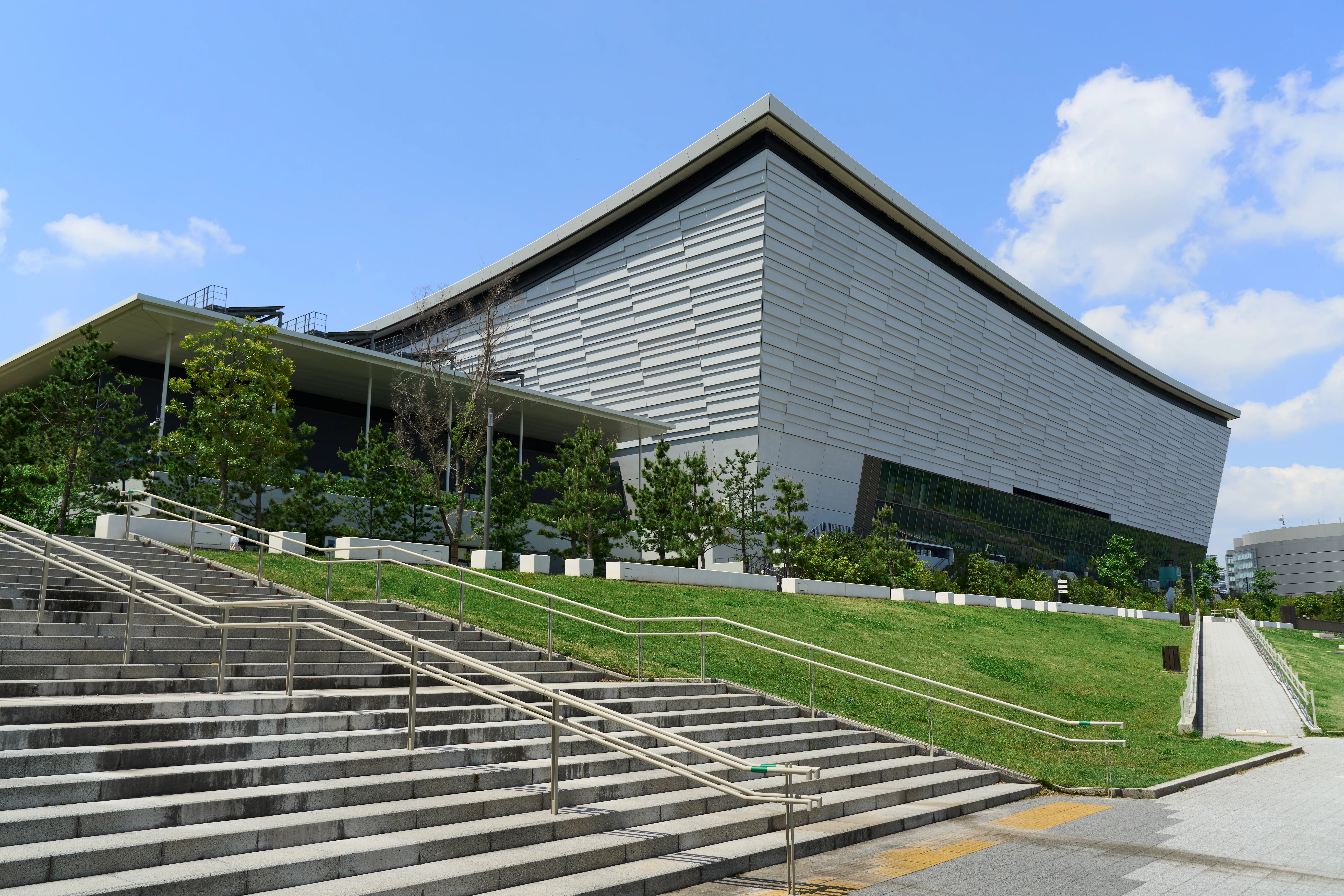
Comprehensive Guide: Ariake Arena
Everything you need to know about Ariake Arena, a modern 15,000-seat arena situated in the Odaiba area.
Last Verified Visit: 26 & 27 April 2025
Verdict: Ariake Arena is a modern, high-capacity venue with good sound, solid seating, and decent facilities. Its main downsides are the long walks to every nearby station and a gate system that is more confusing than it should be.
The Good
- 15,000 seats makes it one of the highest capacity venues in its area.
- Venue acoustics are quite good.
- Sightlines are unobstructed.
- Large outdoor space so it never feels crowded close to entry time.
- For a concert venue, the surrounding area is quite scenic.
The Bad
- Long walks to nearest stations, plus the paths can bottleneck.
- Outdoor toilet situation is miserable. Use the toilet early or come prepared.
- The indoor gate numbering and layout can make your gate harder to find than expected, so factor in extra time.
- No real shelter around the area, including the walking paths, be prepared in the event of bad weather.
| Key Information | Details |
|---|---|
| Name | Ariake Arena (有明アリーナ) |
| Official Website | https://ariake-arena.tokyo ↗ |
| Capacity | 15,000 |
| Area | Ariake (有明), Koto City (江東区), Tokyo Metropolis (東京都) |
| Closest Stations | 1) Shin-toyosu Station (新豊洲駅) 2) Ariake-tennis-no-mori Station (有明テニスの森駅) 3) Kokusai-tenjijo Station (国際展示場駅) 4) Shinonome Station (東雲駅) |
| Coin Lockers | 91 (north entrance) 54 (south locker room) |
| Oversized Item Cloak | Not available |
| Nearest Convenience Store | FamilyMart Koto Ariake (ファミリーマート 江東有明店): ~200 m |
| Parking | No parking for event attendees |
| Taxi | No taxi stand. |
| Food/Drink in Venue | Yes, |
| Entry Drink Charge | No. |
These guides are updated as venues change. Subscribe to the newsletter to get notified when this or any other guide is revised, re-visited or expanded.
Background#
Ariake Arena was originally built as a sporting venue for the Tokyo 2020 Olympic Games. It hosted volleyball and wheelchair basketball games. It is the first public sport facility in Japan that is owned and managed by the local government but operated by a private for profit company.
After the Olympics, it reopened in August 2022 and has since continued to host both sporting events and concerts.
Basic Access#
Ariake Arena is easiest to access by train. You have four realistic station options:
- Yurikamome Line (ゆりかもめ): Shin-toyosu (新豊洲駅), Ariake-tennis-no-mori (有明テニスの森駅).
- Rinkai Line (りんかい線): Kokusai-tenjijo (国際展示場駅), Shinonome (東雲駅).
Shin-toyosu and Ariake-tennis-no-mori are the closest two stations. The Yurikamome stations are less than 1 km away on foot while the Rinkai Line stations are both around 1.5 km away.
Which line makes the most sense will usually depend on where you’re staying, so in most cases the best move is simply to choose the most convenient station and walk from there.
There’s also a bus option. The nearest bus stop to Ariake Arena, Ariake Sho Chu Gakko Mae (有明小中学校前) get served by one bus, but it’s effectively doorstop access which can be very appealing. The bus line, 都05-2 goes from Tokyo station Marunouchi-Minamiguchi and ends at Tokyo Big Sight. One of the other major stations it passes through is Yurakucho station. If you’re able to utilize this, it is likely to beat using the train.
Walking Routes#
Note that all the walking paths are mostly unsheltered! Be prepared in the event of wet weather.
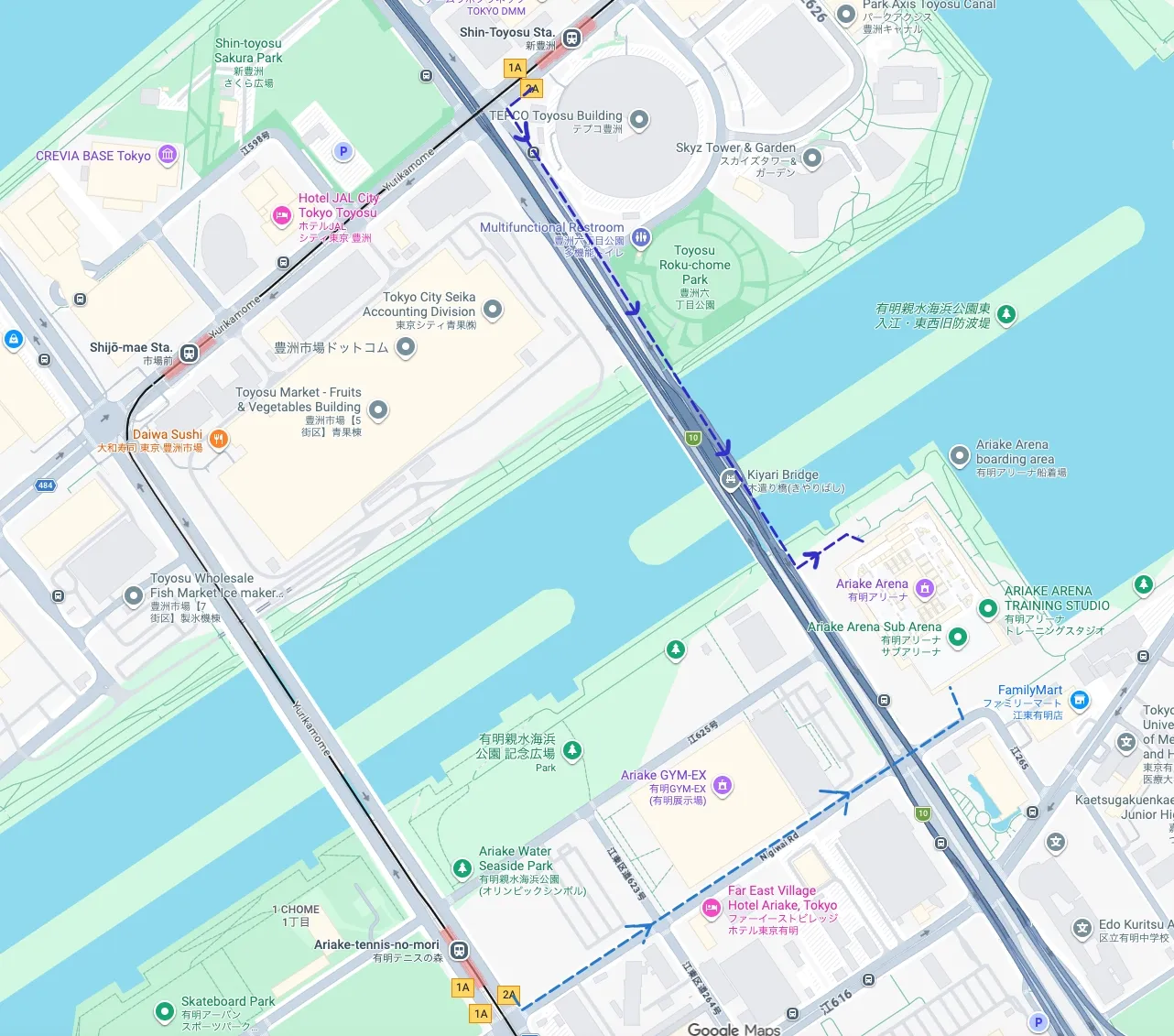 Walking routes from the Yurikamome Line stations
Ariake Tennis no Mori Station (800m)
- Use exit 2A. Elevator exit is available.
- You’ll see an Audi dealership in front of you. Turn left here.
- Head straight. You’ll pass Ariake GYM and end up at a large crossing.
- Ariake Arena is just straight across the road.
Shin-Toyosu Station (750m)
- Take exit 2A, there is an elevator exit if you need it.
- Both the lift and stairs exit face the correct direction. Turn left at the junction.
- Keep walking down the road, you should see the top of the venue show up on the horizon, followed by the road and walkway crossing a body of water.
- At the end of the body of the water, look for an opportunity to turn left again which allows you to access the platform that Ariake Arena sits upon.
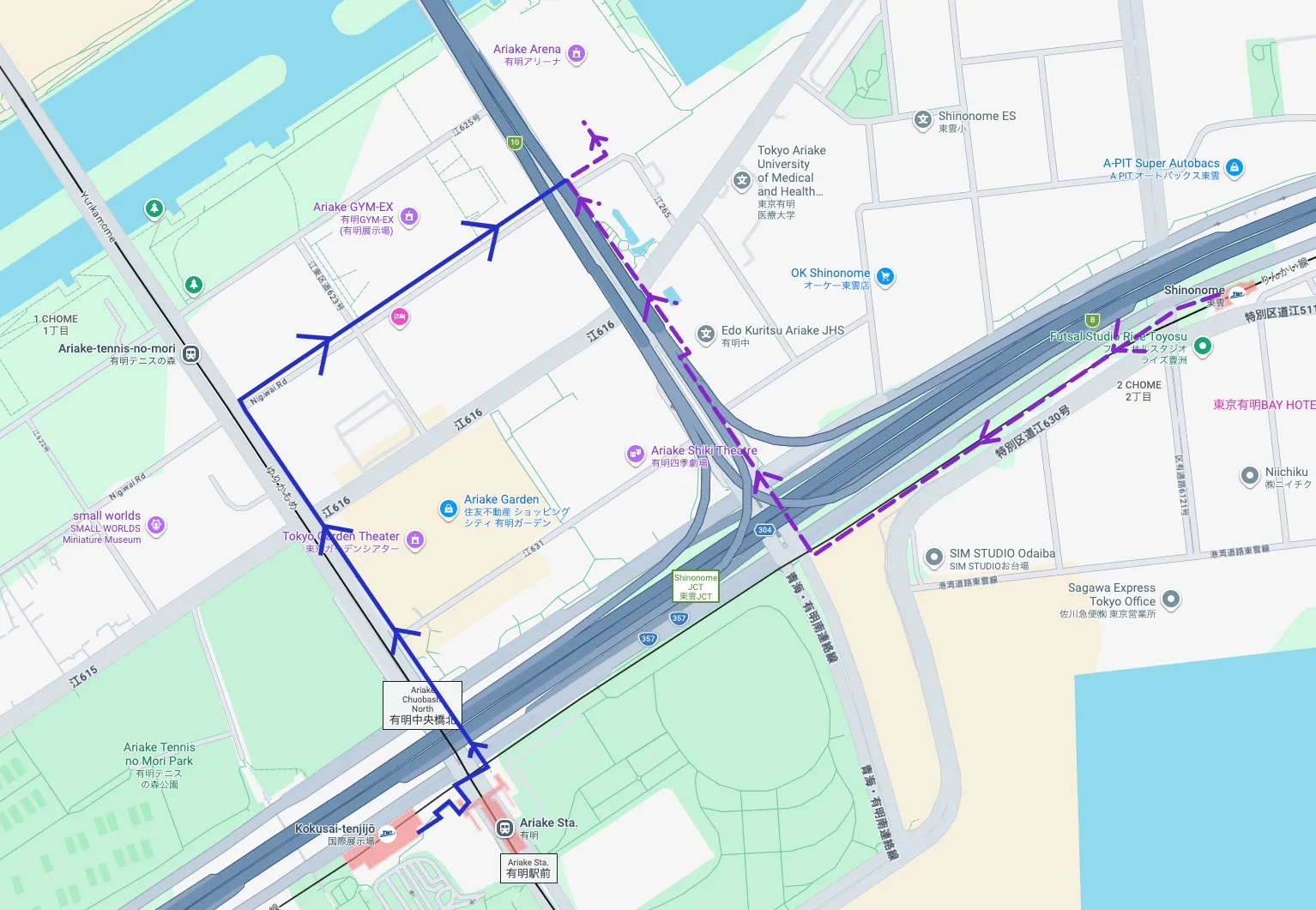 Walking routes from the Rinkai Line stations
Kokusai Tenjijo Station (1.5km)
- From the fare gates, turn left to head towards exit A (side door)
- From there, follow the signs toward Ariake Station on the Yurikamome Line. This will take you up to street level via a set of stairs, with a parking complex on your right.
- Emerge from the stairs at street level and you should see the entrance to Ariake station. You can take the train from here to Ariake-Tennis no Mori or Shin-Toyosu, but it’s not time or cost efficient.
- Walk past the staircase to Ariake station, turning left.
- At the junction, cross the 7 lane road to the opposite side, then continue across the highway.
- As you cross the roads you should see a large arena structure on your left. That’s Ariake Coliseum.
- From that point you want to keep walking along the road until you see the Audi dealership on your right
- Once you see that, cross the road and turn right.
- Head straight. You’ll pass Ariake GYM and end up at a large crossing.
- Ariake Arena is just straight across the road.
Shinonome Station (1.4km)
- Take exit B which is right of the fare gates.
- In the same direction you should see a junction (this is the closest junction to the exit) which you should cross and keep heading in that direction.
- You will see two things, a lane of the road heading up to connect to the flyover ahead, and shortly after that, a set of stairs that brings you up to that level. Head up those stairs.
- Turn right and follow the road, the path will bring you down a ramp and then to a small one lane crossing to your right.
- After that small crossing, keep going in the same direction.
- Ariake Arena should start to come into view after the next major road crossing
- One more major road crossing after that, and you’ll arrive at Ariake Arena.
Seat Comfort#
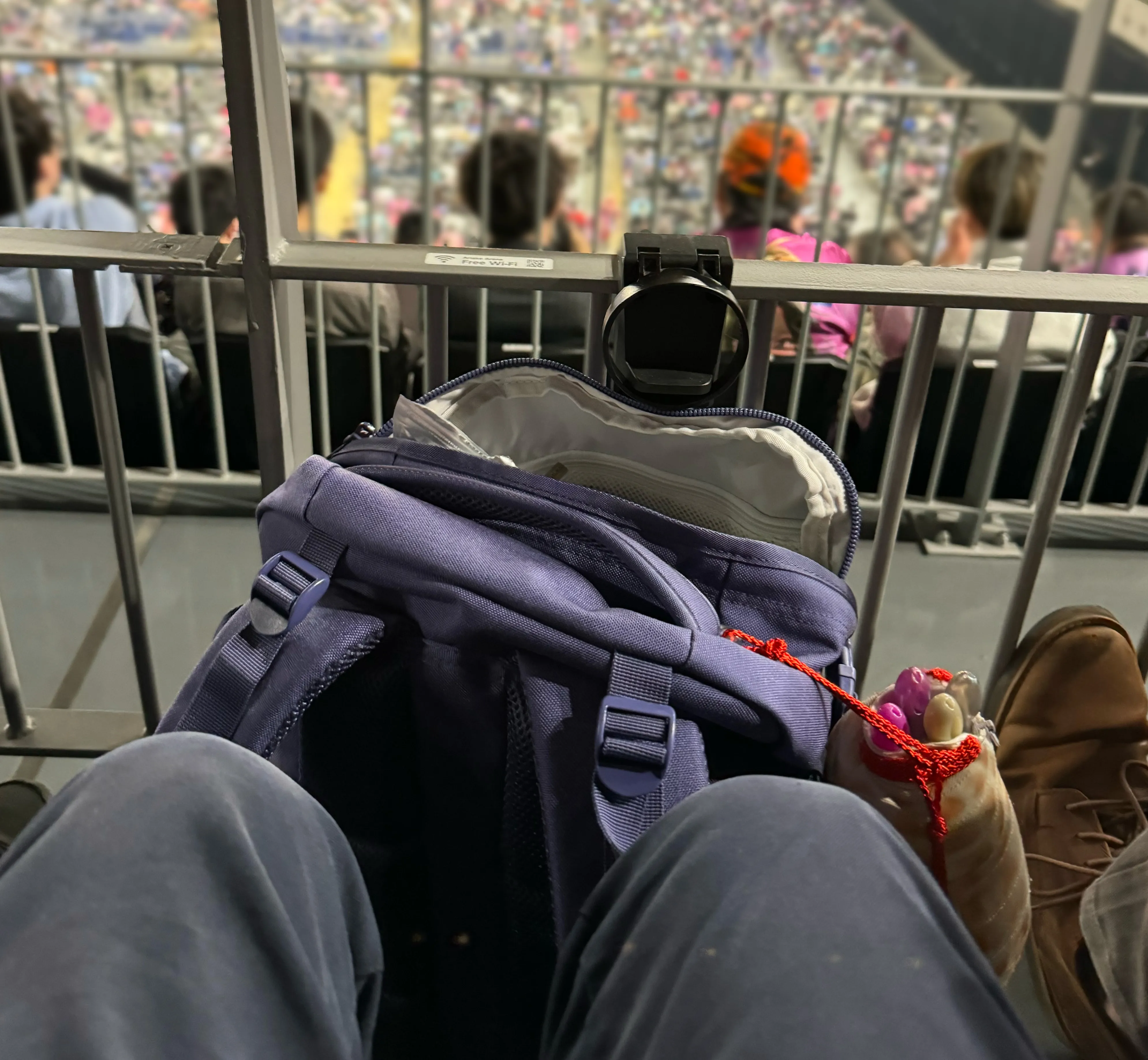 Legroom tested in Ariake Arena with a large backpack. Folding cupholder in view.
Seat comfort in Ariake Arena is above average. The stand level seating consists of typical folding chairs. These are plastic and not upholstered, but feature sufficient width and seat pitch. I could fit a 30L backpack in front of my legs without my knees pressing against the bag. This allows most people to avoid having their legs jammed against the seats in front. The stand floor is also flat enough that you can store belongings under your seat rather than at your feet. Another welcome detail: Each seat’s number is printed facing forward, which eliminates seat guessing based on the row in front of you. Stand seats also provide one fixed cupholder per chair, fixed on the chair in front of you. Front row seats get a collapsable cupholder on the railing in front of them instead, which I very much prefer as it is one fewer thing to intrude on your legroom.
Arena level seating is a different story, since the Arena is designed as a sporting venue, only temporary seating is available at the arena. I didn’t get to sit in the arena on either day, but the temporary chairs looked better than the usual folding pipe-chair setup. Based on similar seating I’ve had at Marine messe Fukuoka, I’d expect them to be acceptable. As you might expect, these chairs don’t come with any cupholders, but provide a good space to stash your bag.
Although I didn’t see it in use myself, the venue does appear to have dedicated wheelchair seating balconies, which could make it a better option for wheelchair users than many similar venues. (I have seen organizers choose to put cameras here though, since some of these are actually too good of a view.)
Here is my legroom evaluation using my standardized legroom test method using a large bag as a spacer. I recommend reading the methodology post to find out what the ratings mean and how the test is done.
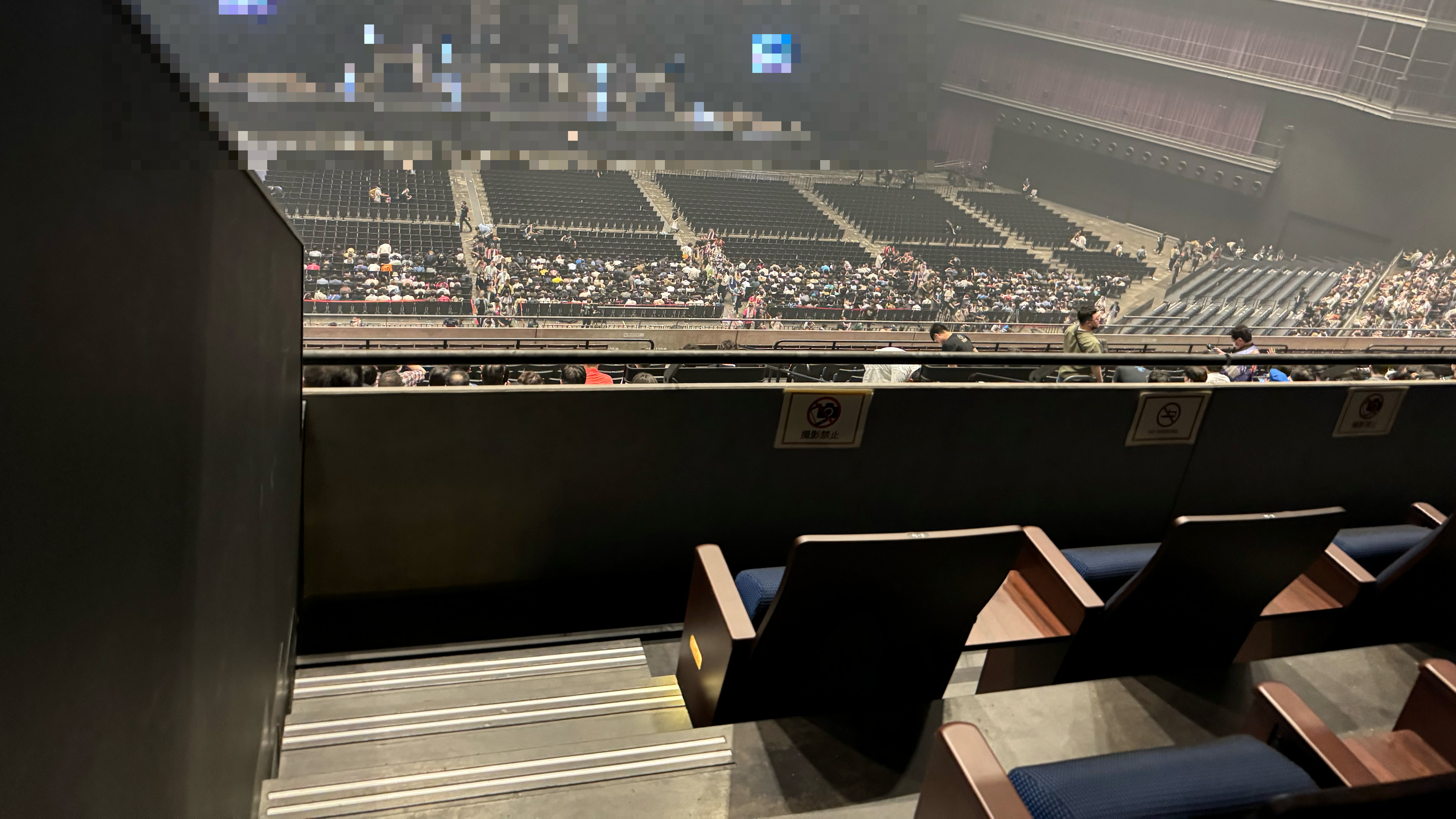
| Location | Rating | Remarks |
|---|---|---|
| Level 1 Arena | Did not test | Seats do not fold |
| Level 2,3,4 Stands | Above Average (No Contact) | Seats Fold, Hard cupholder |
Layout & Views#
Ariake Arena deserves credit here: the official website includes thorough 360-degree views from select spots inside the venue, allowing you to get an idea of the place, and what the views look like before the event. Ariake Arena official Floor Map ↗
Here’s the basic layout: the arena is split across four physical floors. The capacity for each is found in its official facilities pdf here ↗
- 1F arena floor - 2928 seats (20.6%)
- 2F stand floor - 2734 seats (19.3%)
- 3F stand floor - 4408 seats (31.1%)
- 4F stand floor - 4090 seats (28.8%)
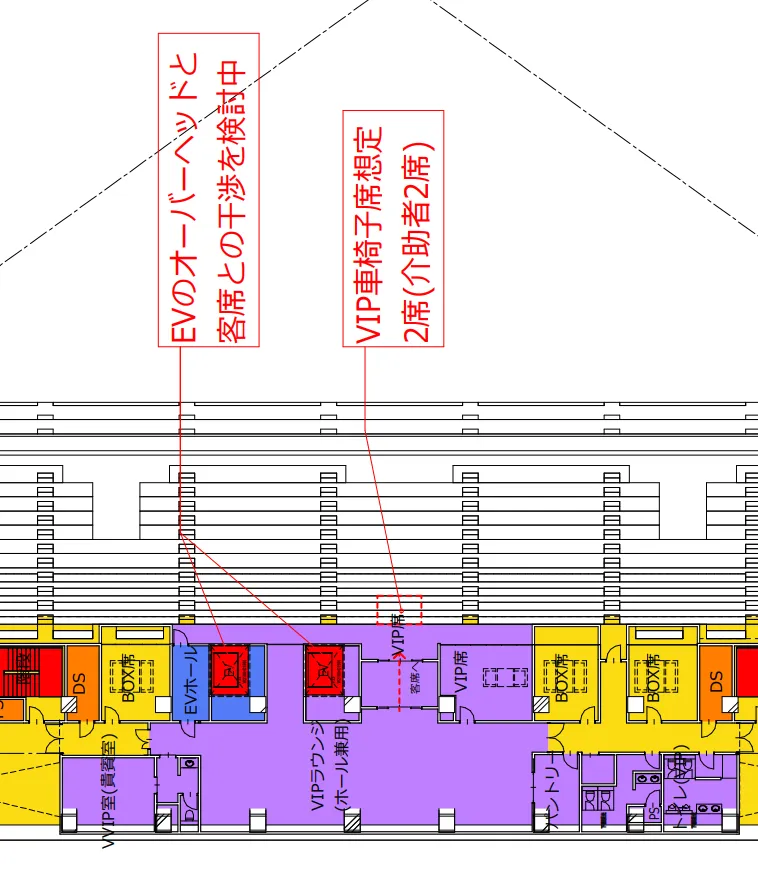
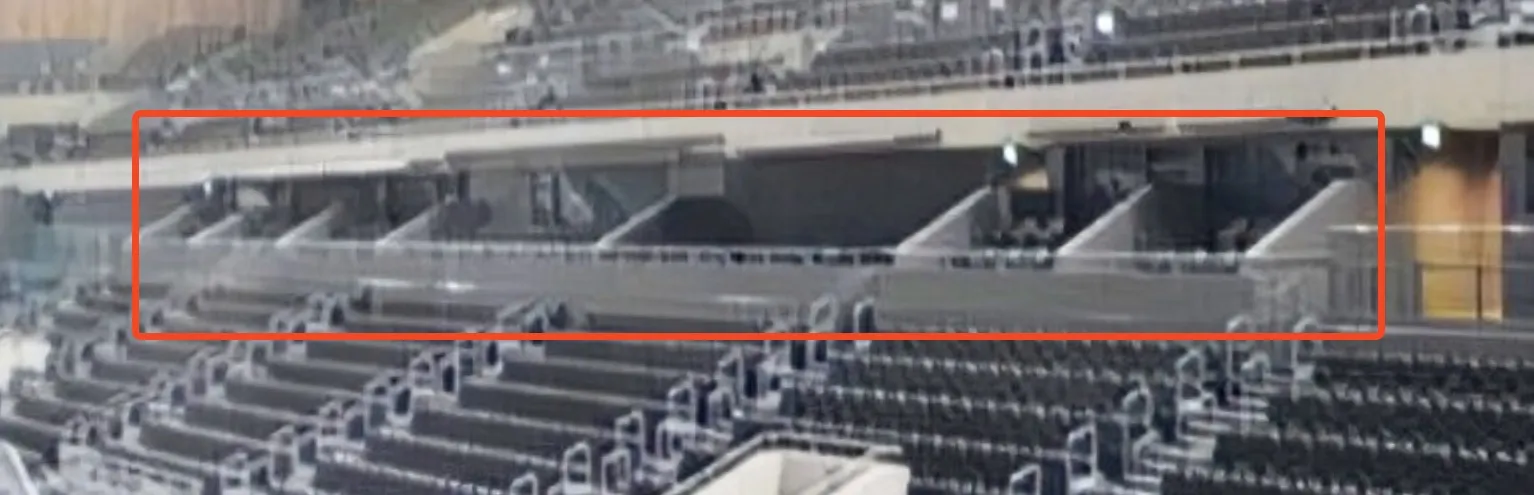 Evidence of a VIP seating area in Ariake Arena
I found evidence of a VIP lounge and seating area in the official 3F schematics and the booking documentation. This appears to be the unlabeled space between the Gate 11 and 27 on the 3rd floor map. As far as regular ticketing goes, I haven’t seen this offered in normal circumstances, so it is probably irrelevant for most attendees. Total VIP box seating appears to be 88.
Note that these figures reflect theoretical maximum capacity, not event-day capacity. Stage configuration can heavily affect capacity and remove entire blocks. For example, a stage-end setup with the stage at A removes seating from 3F block E, which cuts the available seating on 3F in half.
Gate Numbering#
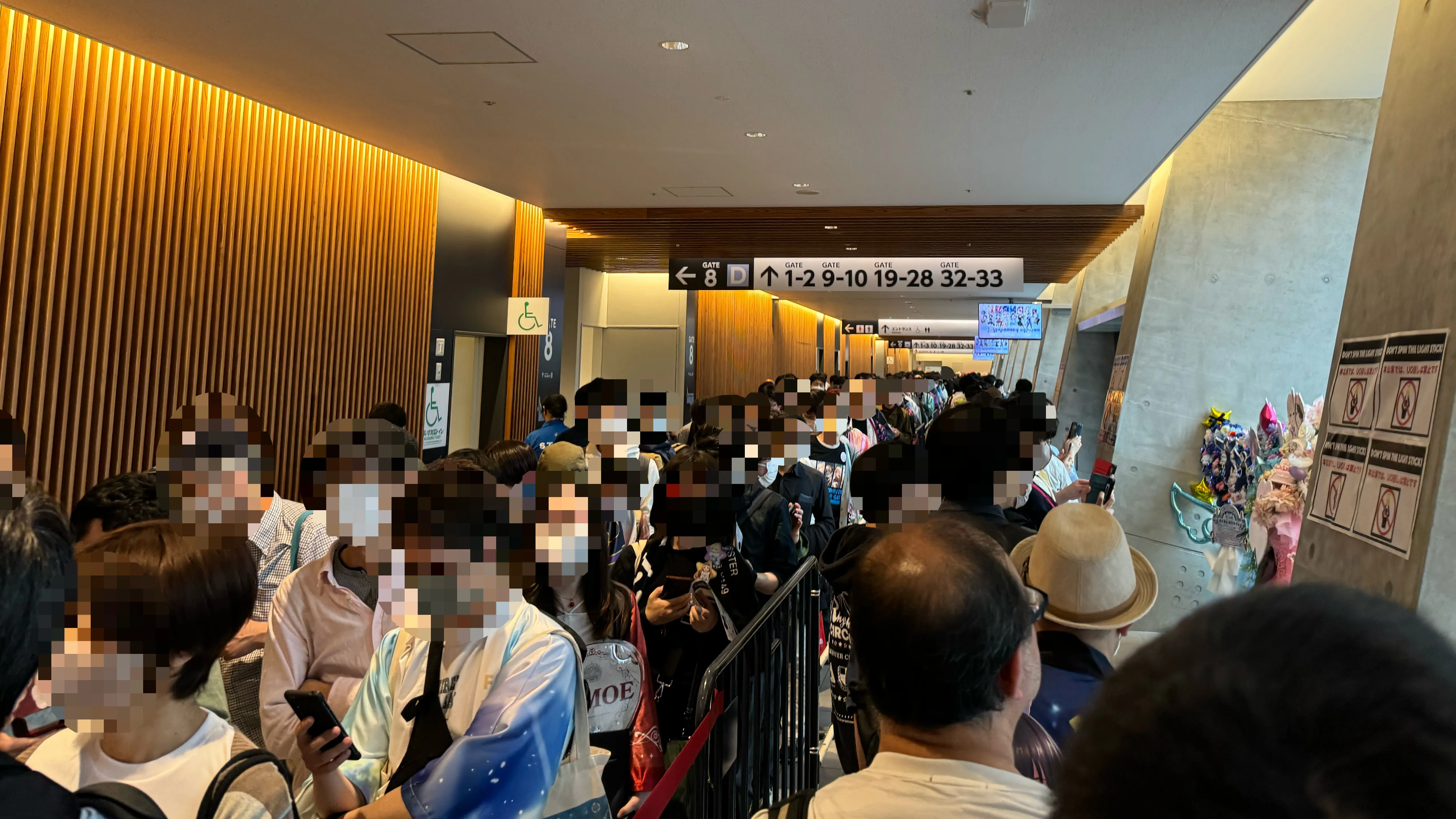 A massive snaking line of people queueing to view flowerstands, which can make getting to your gate even harder.
Now for the part that tends to cause the most confusion: the gates. Ariake Arena gates are numbered 1 to 33, but the methodology they use is inconsistent in places.
- Arena 1F has two gates, 5 and 6.
- 2F stands are gates 1-4 and 7-10.
- 3F stands hosts gates 11 to 27.
- 4F stands are for gates 28 to 33.
This makes a certain amount of sense on paper, but the actual gate locations are not especially intuitive because the logic changes depending on the level.
At the main entrance, gates 1 to 4 are on the left and gates 7 to 10 are on the right. That is the simplest part of the system.
To get to the arena from that level, you have to make half a trip around the arena to find the stairs to gates 5 and 6 at the rear of the venue.
Level 3 and 4 are where the system starts to get unintuitive, because someone decided gate 11 and 27 should be where the two ends of the VIP area are, and the VIP area can’t normally be walked through. To mitigate this, look at your gate number and block carefully.
Here’s what I’d recommend
- If your gate number is 19 to 28, head up via the first stair you see in the venue. By proximity 24-28 will prefer the right staircase labeled 4F F + 3F E next to gate 1 as this is the dead end near the VIP facility.
- If your gate is 28, your dedicated 4F staircase is right by gate 26
- Gates 11, 12, 13 and 29 would prefer the stairs at the inner right corner (entrance relative) labelled 4F F + 3F G near gate 4
- If your gate is 29, your dedicated 4F staircase is right by gate 12
- Gates 14 to 18 can be most easily reached through the stairs at the inner left corner. This is labeled 4F H + 3F G near gate 7.
That deals with the 3F gates and two of the 4F gates near the VIP area. For the rest of the 4F gates here’s the rundown
- Gate 32: Staircase is by Gate 21, take left side staircase 4F F + 3F E, then look for this staircase.
- Gate 31: Staircase is by Gate 17, take inner leftside staircase 4F H + 3F G, then look for this staircase.
- Gate 33 and 30: As far as I can tell, these are only accessible by lift on the two corners of the venue. 33 is the H block lift and 30 is the F block lift.
Unfortunately, the gate numbering is messy enough that, once event-specific crowd control is added on top, finding your gate for the first time can take longer than it should.
One workaround is to focus on your block letter rather than your assigned gate and enter through a nearby gate instead. From there you should be able to find your seat one way or another, as the entire block can usually be walked through.
Views#
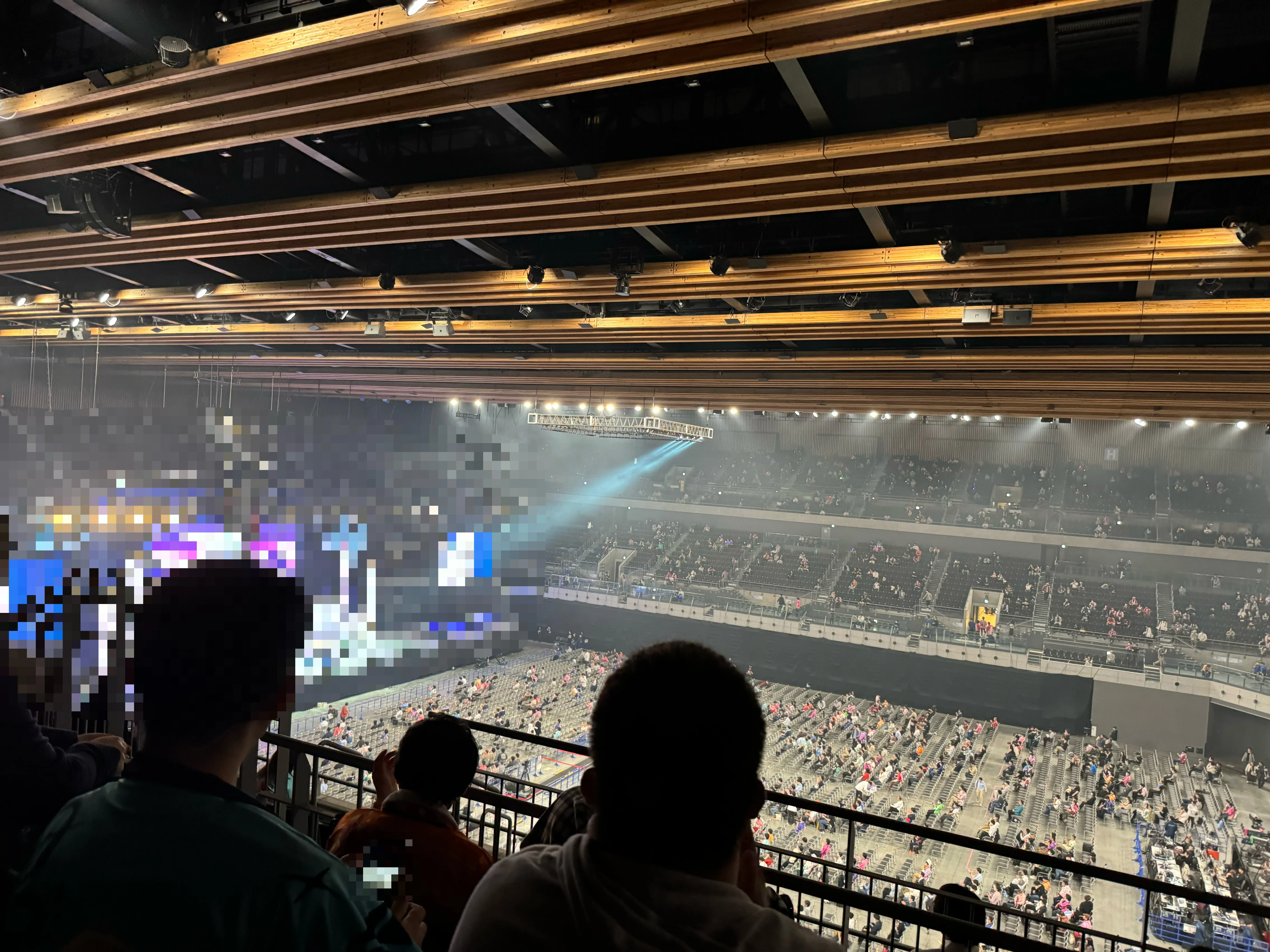 The view from the 4th floor of the venue.
So what is it like to actually try and enjoy a show in this venue? Let’s start from the top to the bottom. Note that these opinions are for stage end configurations, where the stage is positioned at block A/E.
Level 4 feels high enough that you are very aware of the roofline. Sometimes you might struggle a bit to see the performance if you’re shorter. The reason for this is because the level 4 stands run perpendicular to the stage, creating somewhat of a blindspot if there are performers too close to your side of the stage. The upside is that you are often close to screen level, but that comes with trade-offs in direct stage visibility.
On Level 3, G block faces directly toward an E-end stage. It is one of the more conventional and reliable viewing angles in the building. It’s safe and good for almost anyone.
Level 2 has blocks B and D being the main ones, which also run perpendicular to the stage like level 4, but because you’re much closer to the ground, the angle is more optimal for viewing. Some seats on this level can also put you relatively close to the stage, which helps its overall appeal.
As for the arena: It’s completely flat down there, so unless you’re tall or luck into a better position, rear arena seats may struggle for a clear view. It is still arguably the closest you’ll get to the action outside of some very lucky Level 2 seats, so this remains appealing.
Venue Acoustics#
The acoustics in Ariake Arena are good for a sporting venue. The irregular wood patterning near the ceiling seems to do a good job of reducing bounce. In general, I had no major complaints about the sound. Even from a stand seat at the opposite end of the stage, delay and falloff never became distracting.
I will say that this note only applies to stage-end configurations. As a sporting venue there is the possibility of configuring this area for center stage as well and in those cases I am not sure what the difference in sound would be, especially with the different speaker configuration necessary.
Facilities#
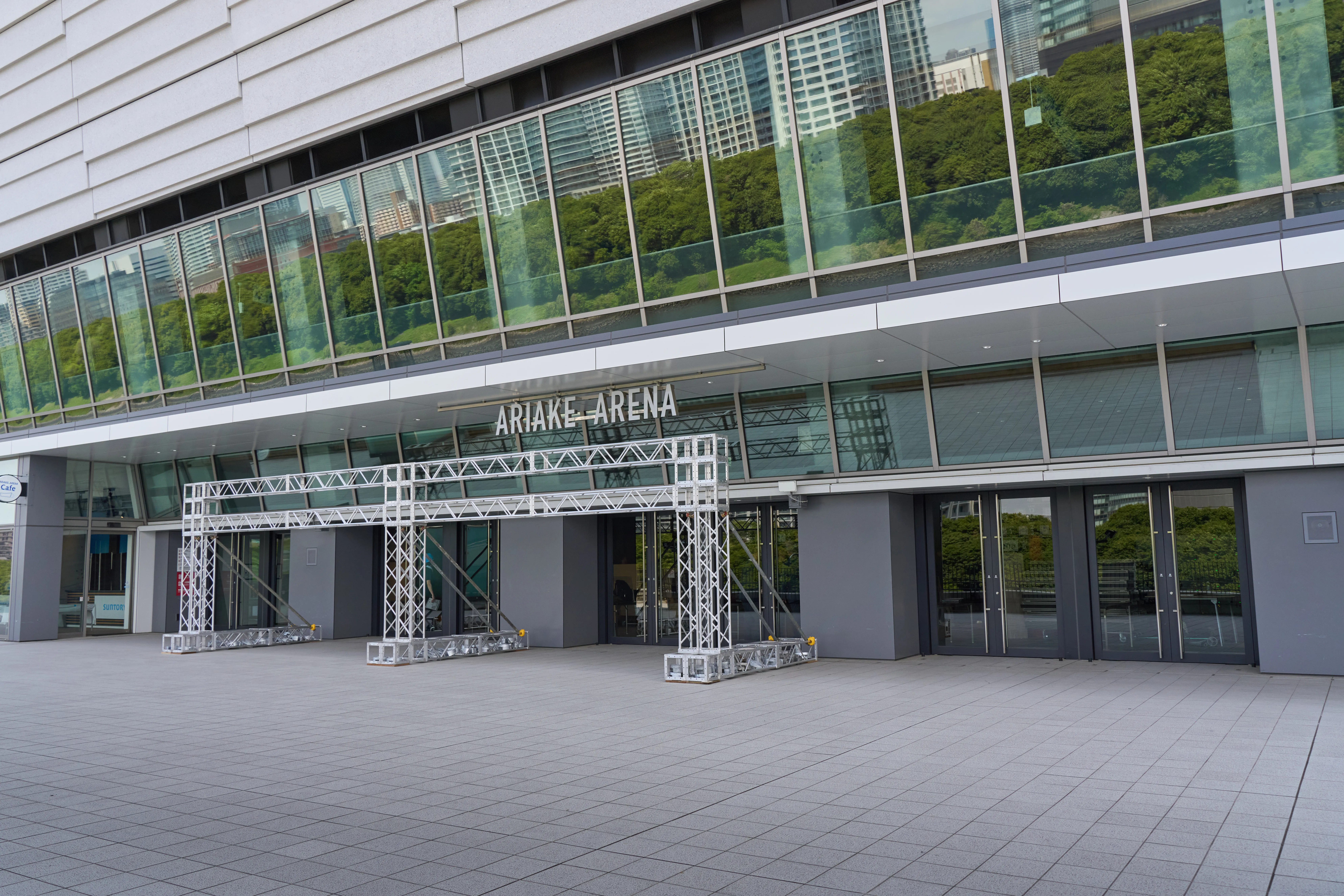 Front entrace of Ariake Arena
Coin Lockers#
Using coin lockers at the venue boils down to two things:
- Can you find a space
- Can you access them easily after the show ends?
Ariake Arena does have coin lockers, but with fewer than 150 in total, availability will be tight whenever demand is high.
They are split across 2 locations:
- 2F North side Main Entrance (Near gate 1)
- 8 Large 8 Medium 75 Small
- 2F South Locker Room (Near Gate 4)
- 6 Large 6 Medium 42 Small
There is no change machine, but the lockers do support IC cards (like suica) and 1000 yen bills in addition to coins.
Given the limited quantity of lockers available, especially of the larger size, I would advise people to make alternative plans instead of counting on the lockers being available. Doubly so if you don’t plan to enter as early as possible.
Toilets#
The outdoor toilet situation at Ariake Arena is poor enough that I would treat it as a genuine issue to plan for, not a minor inconvenience. There is effectively one toilet accessible from the west side or through the sub arena entrance if open. This hosts a small amount of stalls and a queue forms pretty early due to that.
You can also check if the toilet at FamilyMart is available for use, though convenience store toilets aren’t known for moving crowds quickly either.
There’s supposedly a toilet on the 3rd floor of the Sub Arena that may be accessible from outside, but again this depends on whether it’s been opened up for use.
Overall I hope you’ve used the toilet before heading here because it’s not a great set of options.
Inside the venue
Toilets inside the venue is a strong point for Ariake Arena. Plenty of stalls, multiple choices per level (mostly) and relatively newly installed hardware.
First a breakdown by level (stall counts are not officially provided by the venue)
- 1F Arena has 1 large male and 1 large female toilets, with 4 wheelchair accessible toilets and 2 all gender toilets
- 2F Stands has a male and female toilet on each side of the venue, for a total of 4 each. There are 4 wheelchair accessible toilets and 4 all gender toilets, 2 of which are marked wheelchair accessible.
- 3F stands has 6 male and 5 female toilets and 3 wheelchair accessible toilets
- 4F only has 2 wheelchair accessible toilets. No other standard toilet stalls are offered on this level.
Here are some of the key points
- Don’t think about using the 4F toilets at all, head down to 3F so you’re not gambling on the single handicap stall on your side being taken or not.
- 3F toilet sizes are strange and varied. G block has 3 female toilets and 1 male toilet, with the closest male toilet on Gate 13 side being the one at Gate 12.
- This means that for 3F toilet dashes, males coming from gate 14 and 15 should run towards gate 17 and 18 (turn left) instead of turning right
In general, I would consider using the toilet at the venue to be a valid play to make. Toilets are plentiful and the large ones are quite large. If you’re on 4F I recommend using the toilet before the show, as using the toilet from there means running down the stairs.
Small anecdote: The toilet I used inside the venue had heated taps. I’m not sure if this is because it was close to the VIP area, or if its standard in all toilets inside. The reason this is surprising is because the only other venue I’ve been to that had heated taps was the VIP exclusive toilet for the VIP lounge at K-Arena, and that’s an entirely different class of product.
Food & Drink#
There is food and drink available inside the venue, the exact details on which kiosks will open inside the venue will vary by event. But what we do know is the menu of the shops, which all sell the same thing.
The in-venue selection looks fairly standard: popcorn, fries, sausages, and similar low-commitment event food. (Not even hot dogs like the entrance cafe!) The asking price is similarly high compared to what you should be paying for elsewhere.
I’m not sure if the alcohol will be available on all shows, since some organizers typically prohibit drinking at their events. I didn’t recall seeing people holding beers at the events I’ve been to.
Where to eat before the Show#
Near the venue, food selection is limited. But there are options further out. First lets cover the nearby choices:
- Ariake Arena Cafe right by the main entrance will open to sell you food and drink nearer to opening time. The selection is limited to hot dogs and finger food. It does not look especially good value, but it is convenient.
- Ariake Arena Dining MOON RIVER is a restaurant near the Sub Arena. It opens 11:30 to 15:00 for lunch and 17:00 to 21:00 for dinner. A mostly western selection with pizza, burgers and waffles all starting from 1300 yen.
- There’s a FamilyMart about 200 m from the venue where you can pick up basic combini food. Useful for snacks or basics, but probably not a real meal solution for most people.
The two Ariake Arena food options have their menu PDF provided on the official website ↗
If you are willing to walk a few junctions the options open up slightly, with a few restaurants around the area. Ariake Garden near Ariake station is the first major food cluster. (Approximately 1km walk) Closer to Tokyo Big Sight you will have a few more dining clusters with options like restaurant chains and fast food.
For even more options, a short train ride to Odaiba station will give you access to a food court and two entire malls of restaurants.
Exiting & Crowd Control#
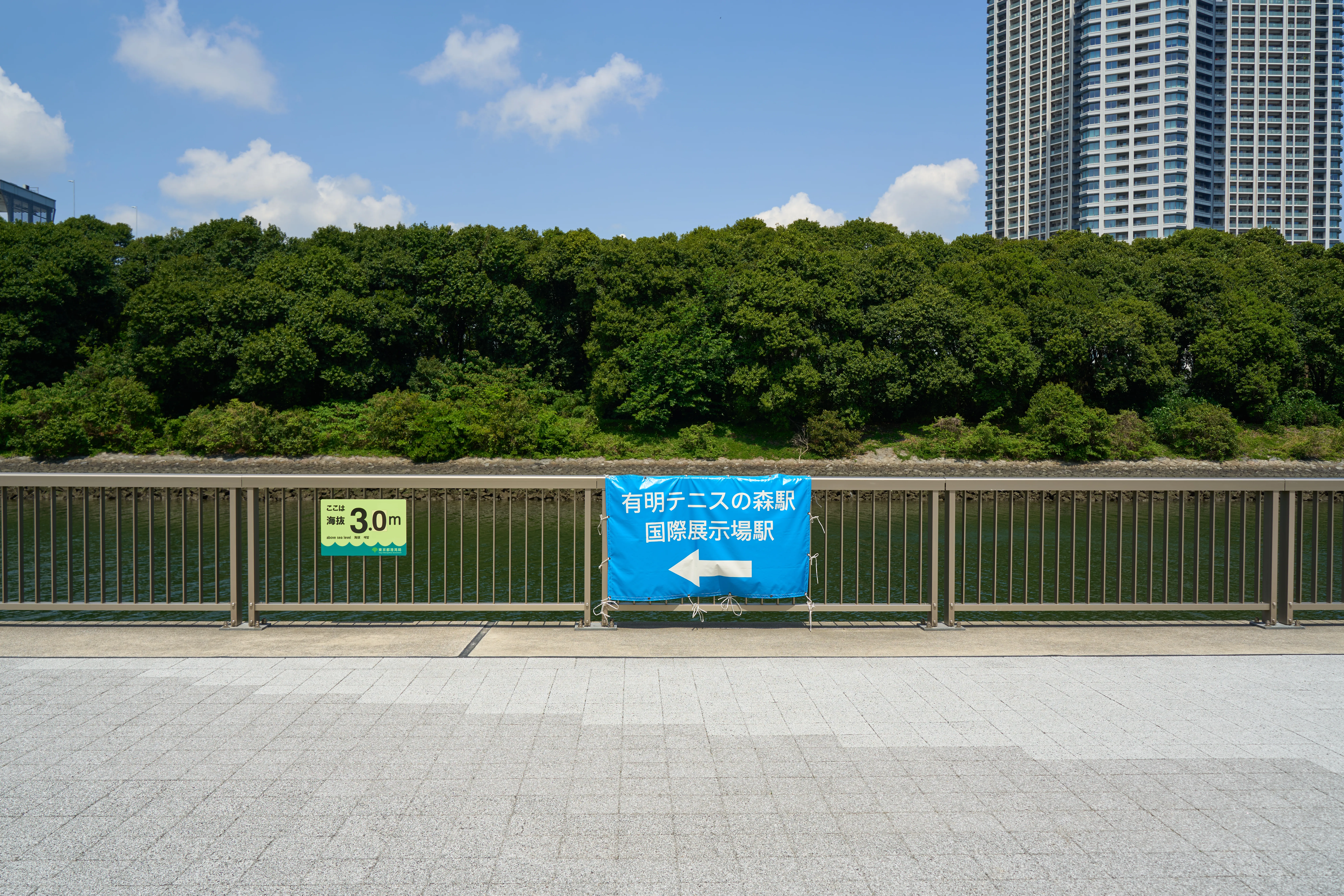 Sign directing people to return to the train station at Ariake Arena
Crowd control is not one of this venue’s strengths. Even with competent staff, the surrounding layout creates unavoidable choke points. While this means that it’s unlikely that the train platforms and capacity will be the bottleneck, it does mean that you might end up stuck behind a very slow moving line.
First I will provide the walking routes that we were allowed to traverse during crowd control, along with the choke points circled in black.
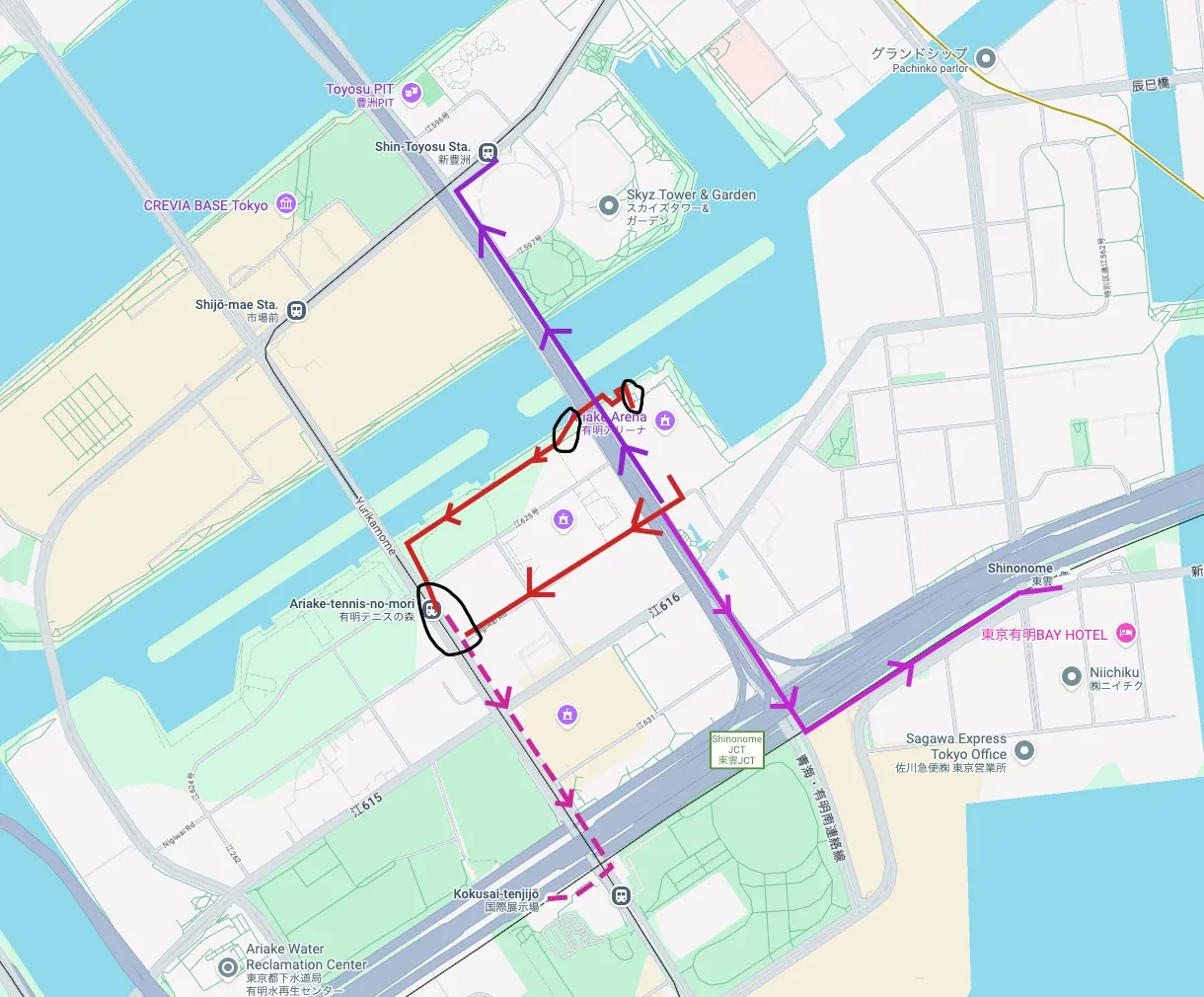 Walking routes during exit control
First note that the walking routes we are allowed to access are very limited. Secondly once you reach the main road, the walkway was split in half with cones and barricades where only one way traffic was permitted in each half. This makes it even more difficult to move quickly, and could make it such that the walkways are even more of a choke point than the waterfront walking segment.
Because of how limited your choices are and how restricted the paths are, I would recommend picking a station and committing to it. Shin-Toyosu and Shinonome stations are the pairing where you are most likely to escape from the crowd quickly. Ariake Tennis no Mori would be the number 1 crowding destination while Kokusai-tenjijo would require walking past that station (after which it gets a lot better)
Taking the Bus
The bus stop at Ariake Station 有明小中学校前 heads towards Tokyo Big Sight which is not so interesting, but if you cross the road and ride 都05-2, that goes to Yurakucho station and Tokyo station, which is appealing.
I have not tried to do this myself, so I cannot comment on whether this route is highly fought over during exit time. Others I have spoken to say that this route is well known, so expect a queue. With departures only roughly every 15 mins in the evenings and dropping to 30+ mins after 9:40PM, I would start making secondary plans if there’s crowding at the bus stop.
Where to eat after the Show#
Headline info first. Be careful of last order times, closing early is normal in this area.
While the earlier mentioned dining options are still available, one problem is that a lot of the shops near Ariake close at 9pm with last order at 8:30pm, including the McDonald’s across the Kokusai-Tenjijo station. This makes it way too tight to recommend eating here outside of specific shops that close late, like the Saizeriya at the Ariake Frontier Building or some of the 5F shops at Ariake Garden.
In general I’d advocate for settling your meal en route to your hotel or lodging.
- Unless your hotel is on the island you’re going to have to take transport out anyway
- It gets you access to more places that aren’t bound by the 9pm closing constraint
- You have far more options and can dodge the crowd aiming for those select few restaurants near the venue
Where to Stay#
There are three main approaches to choosing where to stay, and each has different trade-offs.
- Stay close to the venue
- Stay outside of the island along it’s connecting direct lines
- Stay somewhere that minimizes time spent dealing with crowd control
Staying near the venue is the first option, but in most cases I do not think it is the best one. There’s not that much to do around the area in terms of amenities and can make general (non-concert focused) trips more cumbersome.
Closest options
- Far East Village Hotel Ariake
- Villa Fontaine Ariake Garden (competes with Ariake Garden Theater attendees)
- DoubleTree by Hilton Tokyo Ariake
Personally I find staying on this set of artificial islands rather expensive and the surrounding amenities are lacking unless you go closer to Odaiba station. That is why I tend to favor options further east instead.
Once you get off the island you have a lot of options, these are the first areas I would check to see if I can find a good price for a room as they connect directly to the Keihin-Tohoku Line and one of the two lines that get you to the venue.
- Shimbashi - Direct connection to Yurikamome line, decent food and hotel options
- Oimachi - Direct connection to Rinkai line, decent food options, direct bus to Haneda Airport
Now if you prioritized escaping from the venue over all else, I recommend looking for lodging along the Yurakucho Line. Yurakucho station in particular is especially interesting due to the direct bus option, so maybe I’d give that a look first before the other stops. You can change to the Yurikamome line at Toyosu station or Rinkai line at Shin-Kiba, which is the direction that less people are heading in after the live. Just be aware that this reduces you to 2 stop connectivity to reach the venue, and the closer options on the Yurakucho Line don’t strike me as particularly appealing for amenity or affordability reasons.
Conclusion#
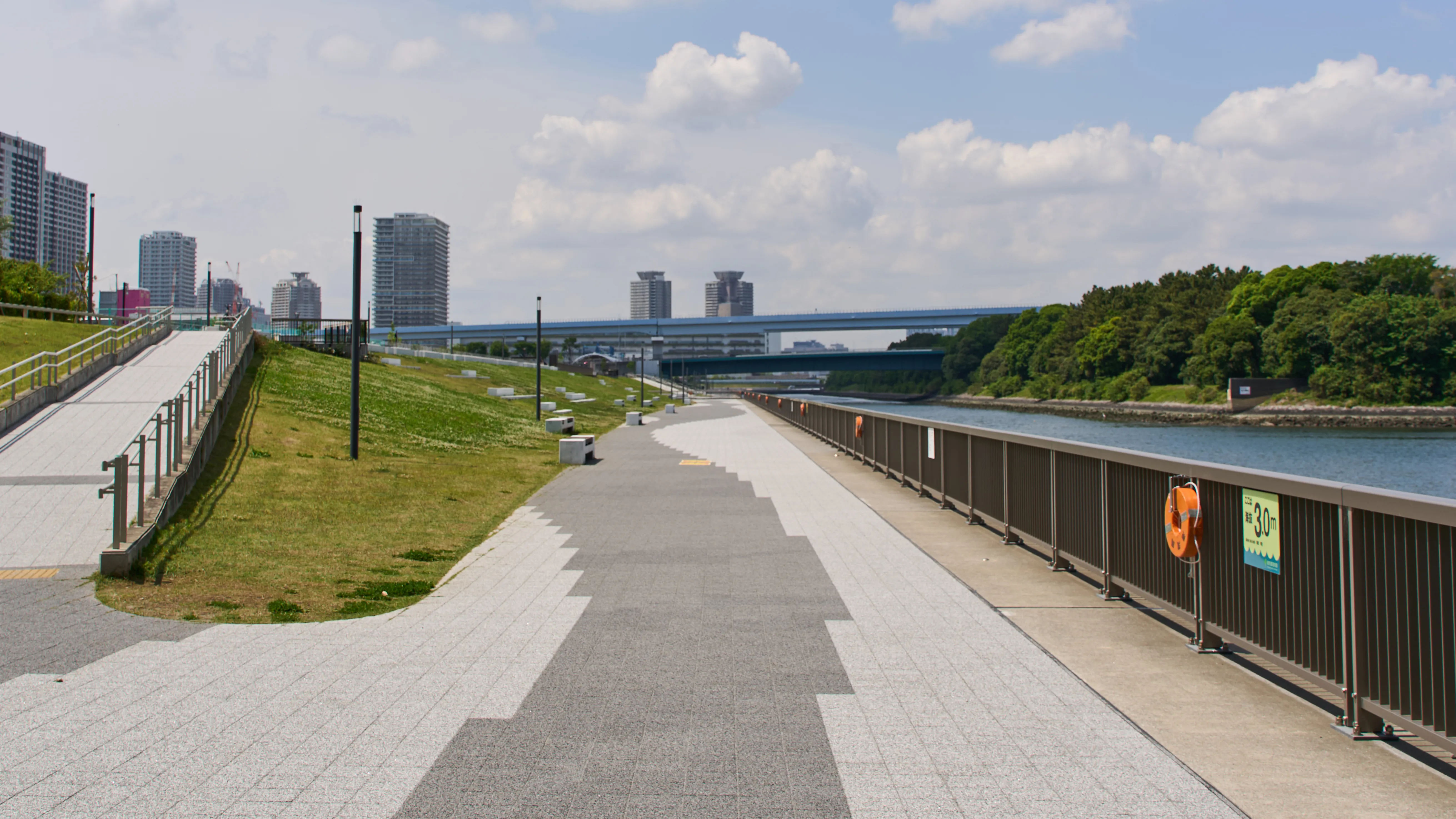 The leftmost walkway is a big choke point during exit control, especially if the wide walking path is deliberately blocked.
Overall, I come away positive on Ariake Arena. It handles large crowds well from a seating and sound perspective, and the surrounding area was pleasant enough that I came back a third time just to photograph it. Unfortunately, the sheer distance to the train stations and the early closing of food places nearby are tangible downsides that you feel. If you go in expecting the walks and limited nearby options, the overall experience should still be a good one.
If this guide was useful, the newsletter is worth a look. It covers updates and revisions to guides like this one whenever venues change or a new visit warrants it, so the information you’re relying on stays current. Occasionally it features other pieces that don’t fit the guide format but are worth your time if you’re navigating live events in Japan.
Subscribe Here