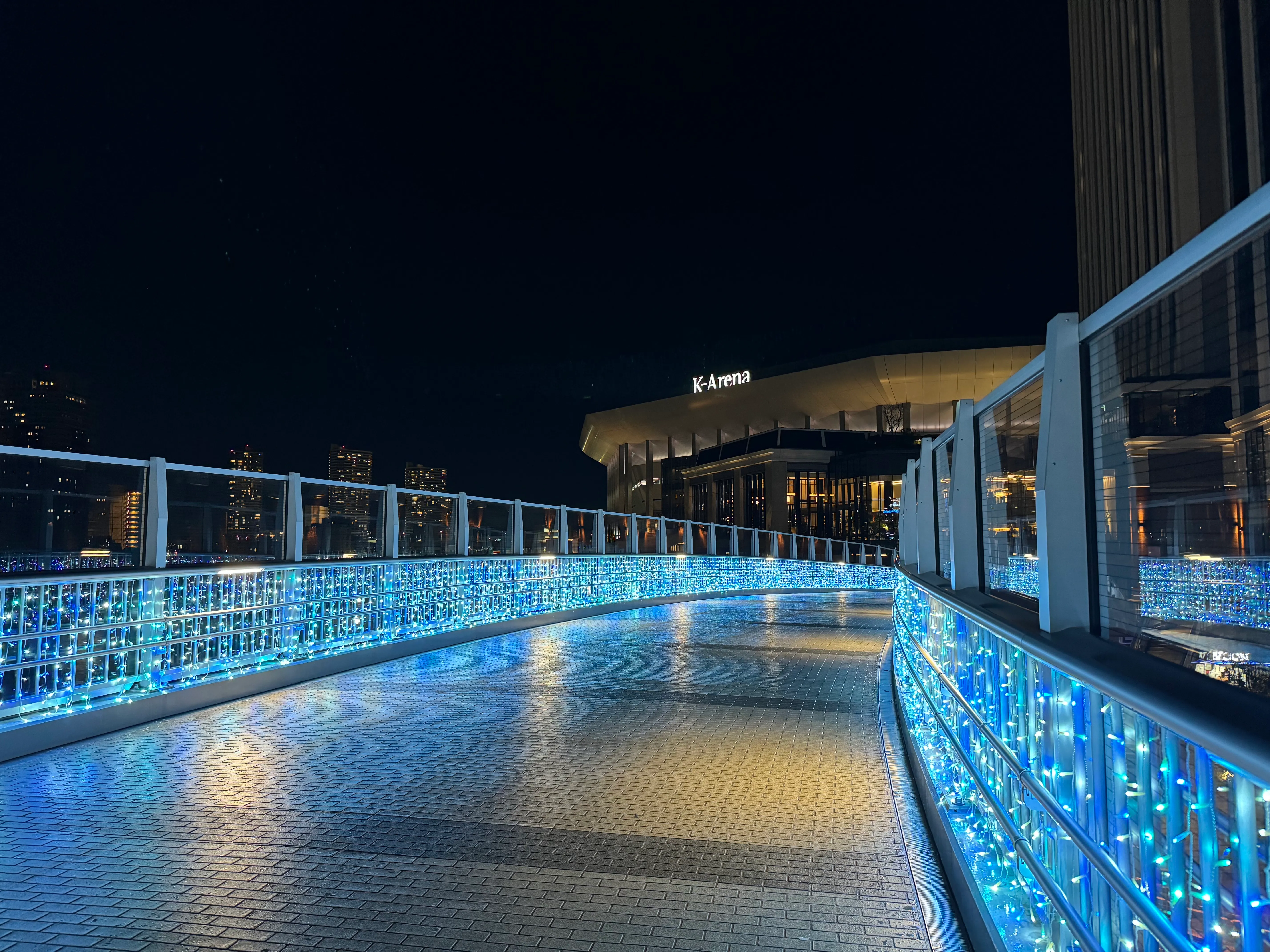
Comprehensive Guide: K-Arena Yokohama
Everything you need to know about K-Arena, a modern 20,000-seat arena situated in Shin-Takashima near Yokohama.
Last Verified Visit: 6 & 7 Sept 2025
Verdict: K-Arena is a modern 20,000-seat arena with generally clear sightlines, strong in-venue amenities, and easy access from Yokohama Station but post-show exit control can bottleneck. If you have a tight connection, leave a few minutes early.
The Good
- Access is good, walking distance to Yokohama station being a highlight, 12 train lines service this station.
- Unusual amenities for a concert arena: Arena Bar (often open after shows), plus a high-end VIP lounge.
- Doorstep hotel option: Hilton Yokohama (next to the venue).
- Large outdoor terrace handles full-capacity crowds and merchandise sales well.
- Comfortable standard seats for an arena, and excellent indoor toilet capacity.
- Clean sightlines overall, no pillars blocking the stage in the main seating bowl.
The Bad
- Terrace choke points can make exiting slow if crowd control is poorly managed; budget extra time.
- Approximately 33% of all seats are on Level 7, which can feel quite distant from the stage
- Nearby hotel prices can spike on concert weekends in the Yokohama area.
- Front-row stand seating may enforce a “no standing” rule (event-dependent).
| Key Information | Details |
|---|---|
| Name | K-Arena Yokohama |
| Official Website | https://k-arena.com/ ↗ |
| Capacity | 20,033 (official capacity) |
| Area | Minato Mirai (みなとみらい), Yokohama, Kanagawa Prefecture (横浜、神奈川県) |
| Closest Stations | Shin-Takashima (新高島) > Yokohama (横浜) > Minatomirai (みなとみらい) |
| Coin Lockers | Yes, both inside and outside. Coins only. (6,240 official amount) |
| Oversized Item Cloak | Yes, K-Arena Shop outside venue |
| Nearest Convenience Store | Lawson (<100m) |
| Parking | May require reservation on event days. Bicycle parking available. |
| Taxi | No taxi stand. |
| Food/Drink in Venue | Yes, cashless only. |
| Entry Drink Charge | No. |
These guides are updated as venues change. Subscribe to the newsletter to get notified when this or any other guide is revised, re-visited or expanded.
Background#
K-arena Yokohama was opened in Sept 2023. Located in the Minatomirai area near Yokohama Bay in Kanagawa Prefecture, this arena of 20,000 seats is larger than any of the others in its neighboring vicinity, including Pacifico Yokohama and Yokohama Arena. Despite it being relatively new for a live arena, in a year it holds around 140 concerts. That’s more than 2 concerts per weekend.
In the year 2025, Pollstar ranked K-Arena as the number 1 arena worldwide by number of tickets sold, surpassing big names like Madison Square Garden in New York. That means K-Arena is an established big player in the Japan venue space, and more and more artists and promoters will continue to choose it. If you’re into concerts, this venue is one of the places to know well.
Basic Access#
K Arena is served by 12 train lines
Yokohama Station (横浜駅) ~1km
- Blue Line (横浜市営地下鉄ブルーライン)
- Keihin Tohoku Line (京浜東北線)
- Keikyu Main Line (京急本線)
- Minatomirai Line (みなとみらい線)
- Narita Express (成田エクスプレス / N’EX)
- Negishi Line (根岸線)
- Shonan Shinjuku Line (湘南新宿ライン)
- Sotetsu Line (相鉄線)
- Tokaido Line (東海道線)
- Tokyo Line (Tokyu Toyoko Line / 東急東横線)
- Yokohama Line (横浜線)
- Yokosuka Line (横須賀線)
Shin-Takashima (新高島駅) ~ 600m & Minatomirai (みなとみらい駅) ~1.1km
- Minatomirai Line (みなとみらい線)
The Minatomirai line can be accessed from Shin Takashima or Minatomirai. However, do note that non-local trains Express, Limited Express and F Liner Limited Express (急行、特急、Fライナー特急) trains, do not stop at Shin-Takashima.
Between the 11 train lines, plus a transfer option from Yokohama to Shin-Takashima via the Minatomirai Line to cut walking distance, access to K-Arena is generally quite good.
Walking Routes#
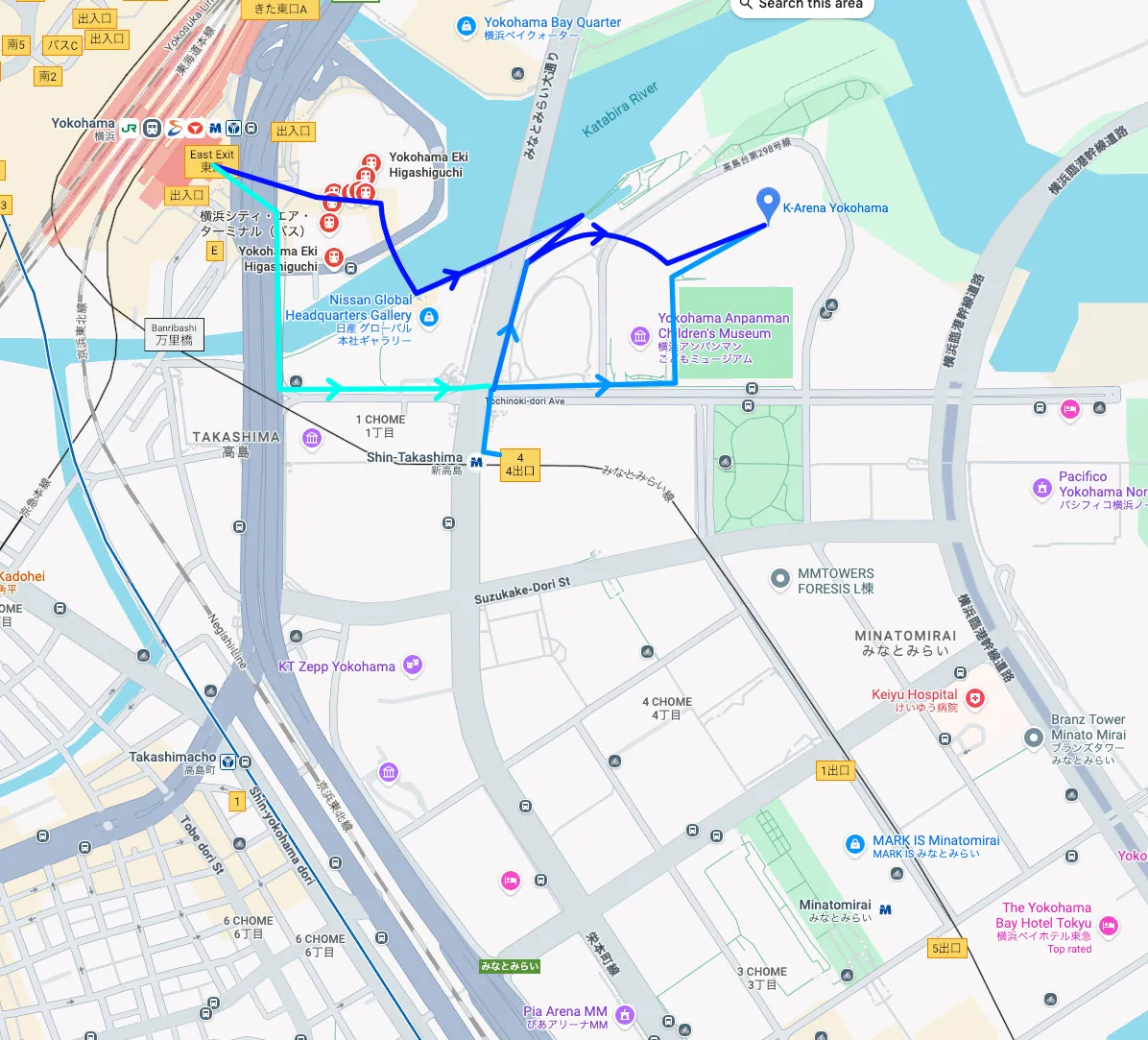 Walking routes from Shin-Takashima and Yokohama
The walking route from Shin Takashima is straightforward. Take exit 3 or 4, which have escalator access if you’re bringing large items. If you’re looking for the elevator to ground level on exit 3, from the fare gates it’s the lift on the right that goes straight to the ground level. From there you can cross the junction straight ahead and continue right until you get past the Anpanman museum. That’s your cue to walk up the long open path to the Music Terrace that surrounds K-Arena. Climb the stairs and you’ll arrive at the venue. This route measures about 30m longer but avoids the incline of the deck.
Walking from Yokohama has two obvious routes, one has you walking through YCAT and across the Hamamirai Walk towards the Nissan HQ Gallery. This is route is around 900m.
The other has you approach from the front by crossing the big road in front of the station and then taking a direct route by the main roads. This route is about 1km long
For the visual learners among us, I have selected a high quality Japanese guide that shows the walking route in great detail.
Either way the biggest risk is rain, as neither routes are 100% sheltered. Having experienced walking to the venue in a typhoon, I would recommend coming from Shin-Takashima in adverse weather, as that at least gives you the shortest route with some light shelter and buildings to block wind and rain.
Seat Comfort#
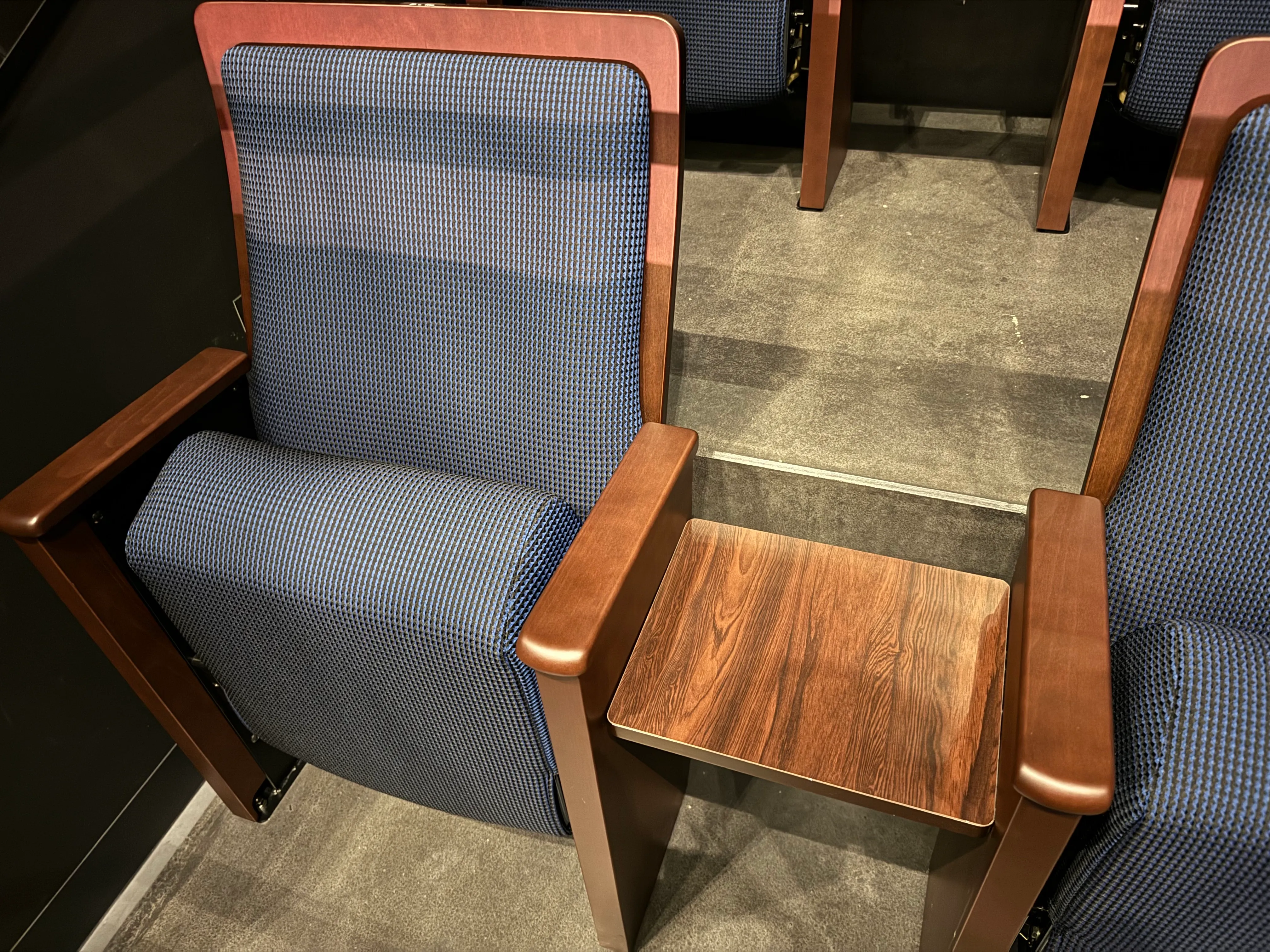 VIP Box seats (Cadenza TS-71 with custom upholstery)
K-Arena has solid physical hardware seats for a modern arena. The seat alone should not be the sole factor for deciding what to ticket for, but understanding the seat will help set expectations for the venue.
The seats are supplied by Kotobuki Seating ↗, and the venue largely avoids the common arena downgrade of “temporary pipe chairs” on the floor. The standard seating is upholstered rather than bare plastic, and many seats include up to 2 cupholders on the seatback (in front rows, integrated into the armrests instead).
If you care about legroom: official specs referenced by the seat maker recommends ~900mm seat pitch (roughly comparable to premium economy spacing). This means that you won’t have your legs jammed up against the seat in front of you.
There are three seat “tiers” worth knowing about:
- Standard seats (most of the building): Kotobuki’s Lux-series ↗ retractable seating (likely Lux-M). Upholstered, with cupholders; generally above average for an arena.
- Balcony seats (front rows of Level 5): A more premium chair model (Kotobuki Cadenza TS-71 series ↗), typically with a cupholder per armrest.
- VIP box seats (Level 6): Same underlying chair model as the balcony, but configured as a premium experience (custom upholstery/patterning by FABRIKO; side tables instead of cupholders).
The absence of pipe chairs means that no matter where you land, seating comfort is good. From personal experience, the seats for the Balcony and VIP box are particularly good for a live venue.
Here is my legroom evaluation using my standardized legroom test method using a large bag as a spacer. I recommend reading the methodology post to find out what the ratings mean and how the test is done.
| Location | Rating | Remarks |
|---|---|---|
| Level 1 Arena | Did not test | Seats Fold, Hard cupholder |
| Level 3,5,7 Stands | Above Average (No Contact) | Seats Fold, Hard cupholder |
| Level 5 Balcony | Did not test | Seats fold |
| Level 6 VIP Lounge | Excellent (Large Gap) | Seats Fold |
Layout & Views#
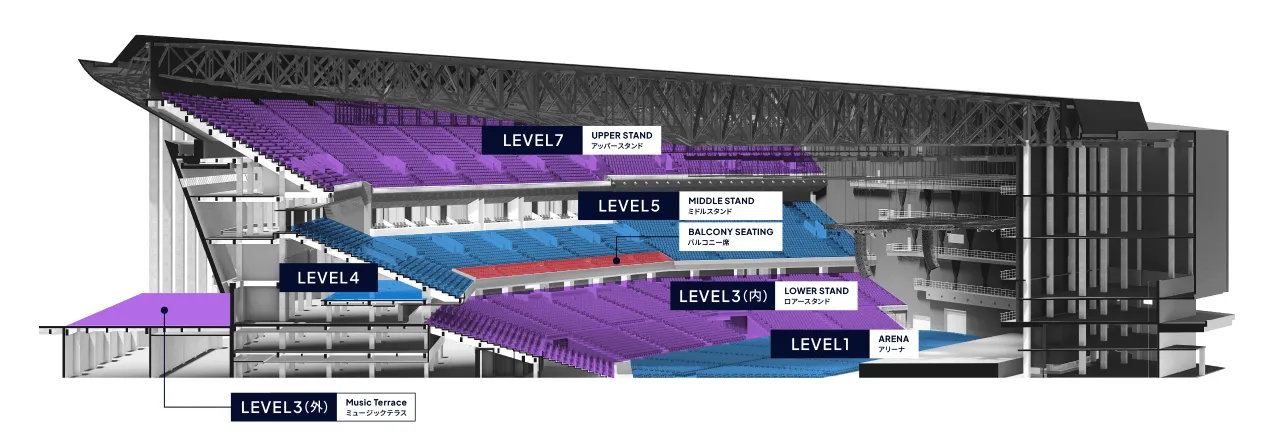 Official Floor map from K-Arena’s website
Most ticketing for Japanese shows assigns seats randomly (sometimes weighted by membership/application rounds), so you can’t reliably ‘pick’ a level. This guide focuses on what each section feels like and how to get the best experience from whatever you’re allocated.
K arena has 4 official seating floors. This will likely be written on your ticket.
- Arena (Level 1)
- Level 3
- Level 5
- Level 7
At least thats what it says on the website, the reality is that there’s a Level 6 set of seating and thats the VIP Box.
Your ticket will usually list a level and a gate number. Gates follow a three-digit pattern where the first digit matches the level (e.g., 3xx for Level 3, 5xx for Level 5). Arena and Level 3 have 4 gates; Level 5 and 7 have 12. Gate 1 starts on the left side of the venue.
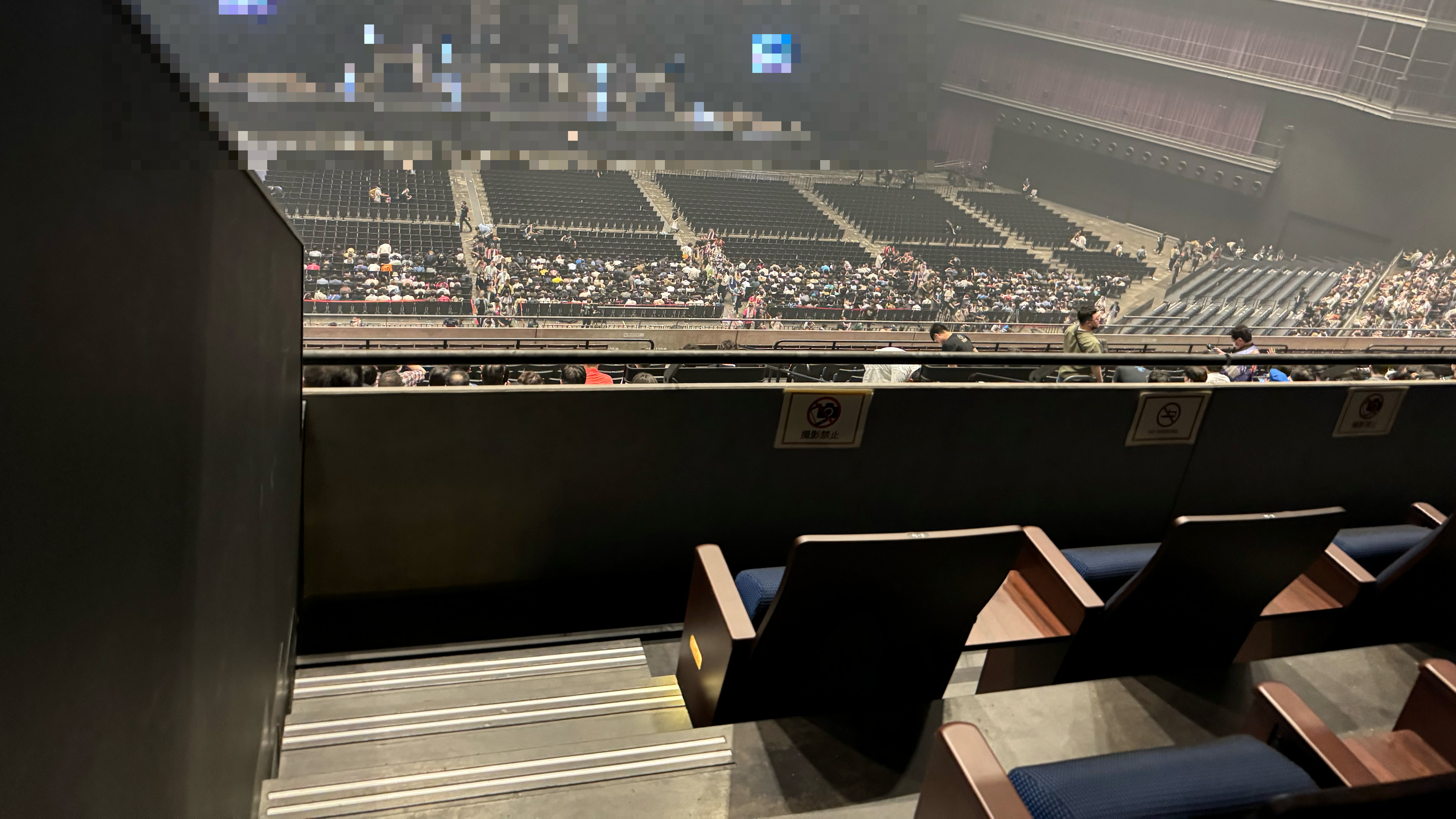
Level 7 is a large portion of the building (roughly 6,000 seats / ~⅓ of capacity), so statistically it’s a common outcome. The main drawback is not a “blocked view,” but the combination of distance + height. The upper half of Level 7 can feel close to the ceiling and more dependent on screens for facial detail. Bring binoculars if you want to spot detail from this level.
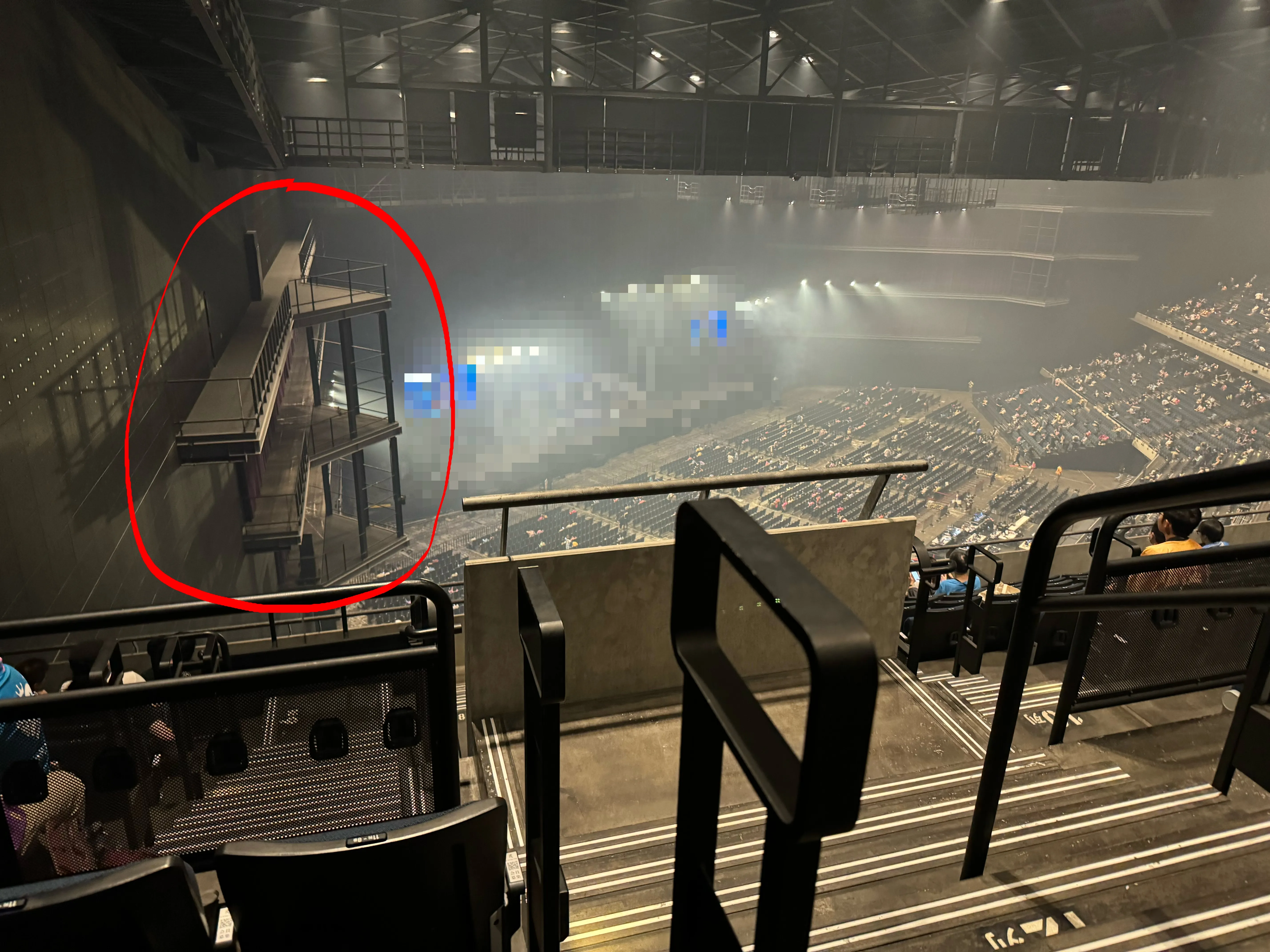 Side catwalk outlined in red. If you sat even further to the left this would be a problem.
Additional pain point: on the extreme left/right edges, a sidewall catwalk can sit in your near field of view. It usually doesn’t fully block the stage, but it can make an already “compromise” seat feel more distracting.
Level 5 is where many people report the venue starts feeling “comfortably elevated” rather than “looking down from above.” You get a better balance of height and distance than Level 7 without losing the benefits of a wider view.
Level 3 is the most consistently satisfying tier for general attendees. Even when Level 5 hangs over parts of the rear, it usually doesn’t feel claustrophobic because the forward viewing angle stays open. Depending on stage design, Level 3 can feel closer to “eye level” with performers than you’d expect in a 20,000-capacity arena. Since stands seating is angled, Level 3 seats are often safer for shorter individuals than Arena, as you aren’t as dependent on height to get a good view.
Arena (Level 1) is where you’re the absolute closest to the action. However, arena only accounts for around 20% of the venue’s capacity and changes to stage layout can hurt this further. Your height matters more in the arena if you want a good view. If you land the extreme left or extreme right arena block, you may find yourself at a little bit of an odd angle to the stage. Photos I’ve analyzed on some show layouts suggest that being front few rows in these extremes could lead to the situation of there being nothing but wall or blackout curtains in front of you, necessitating standing at 45 degrees or more to face the stage or nearest screen. Outside of this edge case, Arena seats can be rather appealing.
I will only briefly touch on the VIP level 6 seats as I intend to make a separate review for that unique experience. The VIP boxes feature individual rooms, split into a balcony that seats 10 in two rows of 5, with the biggest middle room seating 20. I estimate total seating capacity at 120 seats. These are elevated and isolated from the rest of the venue, you have a glass box that you can view the live from as well if you prefer. In terms of viewing angle, it’s closer than any Level 7 seat as they’re directly above you. While this is not the best view in the venue, it gives you a field of view wide enough to view and enjoy the entire lightshow. Considering the kind of people promoters are likely to invite to a VIP box, this view makes a lot of sense.
Venue Acoustics#
K-Arena markets itself as a sound-first venue, and in practice it mostly delivers. Sound has been great in all of the seats I’ve had, with minimal harshness and no nasty echoing. If I had a single complaint, it would be that bass can be rather weak if you’re seated far away. If your goal is to hear the performance, this definitely is a very safe venue to be in.
Facilities#
Coin Lockers#
The official site claims over 6000 coin lockers, and I don’t doubt its factual accuracy. However, my on site inspections show that this is not as simple as it appears. Be aware of the following points:
- Coin lockers inside only come in the small size
- Coin lockers on the outside come in the standard 3 sizes: small, medium and large
- Lockers are coin-operated (bring ¥100 coins) whether inside or outside the venue.
Also take note of the following points that were observed (organizer-dependent):
- Coin lockers on Level 7 near Arena Bar may have to be cleared out after the show
- A large portion of outdoor coin lockers may be fenced off, significantly affecting maximum capacity
- Coin lockers on the inside must be cleared after the performance, coin lockers on the outside must be cleared within an hour, after which the coin locker area will be shut.
- Reaching the outdoor lockers may require walking against crowd flow or asking staff to let you through barricades.
If you’re comfortable with those constraints, lockers can be a good option. In my experience, even when some banks are blocked off, it rarely turns into a mad rush for space. They’re generally way below capacity on the lives that I’ve gone to.
If you have large oversized items to store, officially you are able to utilize K-Arena Shop at the Music Terrace to store items for 1000 JPY each.
Toilets#
Officially, K Arena tells you not to use the toilets of any other neighboring facilities, so which toilets does that leave us with?
There are three toilets that are considered part of the Music Terrace area outside of K-Arena, or part of K-Arena itself listed in its official floor map.
Note that official floor map only shows stall count, and does not reflect urinal count for male toilets. In practice, urinal count usually exceeds stall count by a ratio of 1.5 to 1 or more.
- Outdoor toilet directly belonging to K Arena (2 Male + 4 Female stalls)
- Wheelchair Accessible toilet at the rear of K Arena Shop near K Tower Yokohama (1 unisex stall)
- The toilet under the stairs that go down to the McLaren Showroom (4 Male + 10 Female stalls)
In practice, sometimes people use the toilet at K-Tower Yokohama and there hasn’t been explicit signage telling people not to use these toilets (plus sometimes in summer, K-Tower allows concert goers to loiter at the lobby to avoid the heat) so that is one possible alternative.
The toilet under the stairs is easy to miss; if you need to go close to doors opening, it can be a good first stop because the smaller outdoor toilets often develop a queue.
For more details on the exact layout, refer to the official floor map ↗.
What about indoors?
Indoor toilet situation is where K Arena shines. Let me give you a breakdown by level.
- Arena, 2 toilets, 4 Male + 19 Female stalls each
- 3rd Floor, 2 toilets, 6 Male + 18 Female stalls each
- 4th Floor, 2 toilets, 4 Male + 25 Female stalls each
- 5th Floor, 2 wheelchair accessible toilets
- 7th Floor, 6 toilets, 2x 6 Male + 19 Female stall toilets at the ends, 2x 8 Female stall toilets and 2x 4 Male stall toilets near the middle
Realistically the indoor toilets have an absolute abundance of stalls and urinals, and to boot I think they’re better finished and maintained than the outside toilets. Even the “smaller” 4 stall male toilets on level 7 have enough urinals to keep the crowd moving quick. I would consider using the toilets inside the venue to be a totally reasonable play to make.
Food & Drink#
K-Arena has multiple drink stalls inside the venue. Availability varies by event, so not every counter is guaranteed to be open.
- 2 stalls in Level 1
- 2 stalls in Level 3
- 4 stalls at Level 5
- 2 stalls at Level 7
I don’t recall the exact price of the drink menu. If I get to catch it on my next trip there I’ll update with a photo.
Where to eat before the Show#
Food is a weak spot for the Shin Takashima area, fortunately if you’re not against long walks or taking the train, you do have options.
First, the closest choices to K-Arena
- Lawson (Combini food)
- Hilton Yokohama (Choice of restaurant, reservation may be required)
- Baydeck Grill & Bar
Personally I find that this selection isn’t that great or can get rather expensive. If you eat light, Lawson may provide just what you need, otherwise I recommend looking elsewhere.
Recommended choices
- Yokohama Station (surrounding area and malls have a lot of choices)
- Minatomirai Station (Queen’s Square Yokohama and surrounding area)
- Bashamichi Station (Yokohama World Porter’s and surrounding area)
Between these 3 general locations, people looking to get a full meal before the event at various budgets should be able to find what they want.
Arena Bar 7#
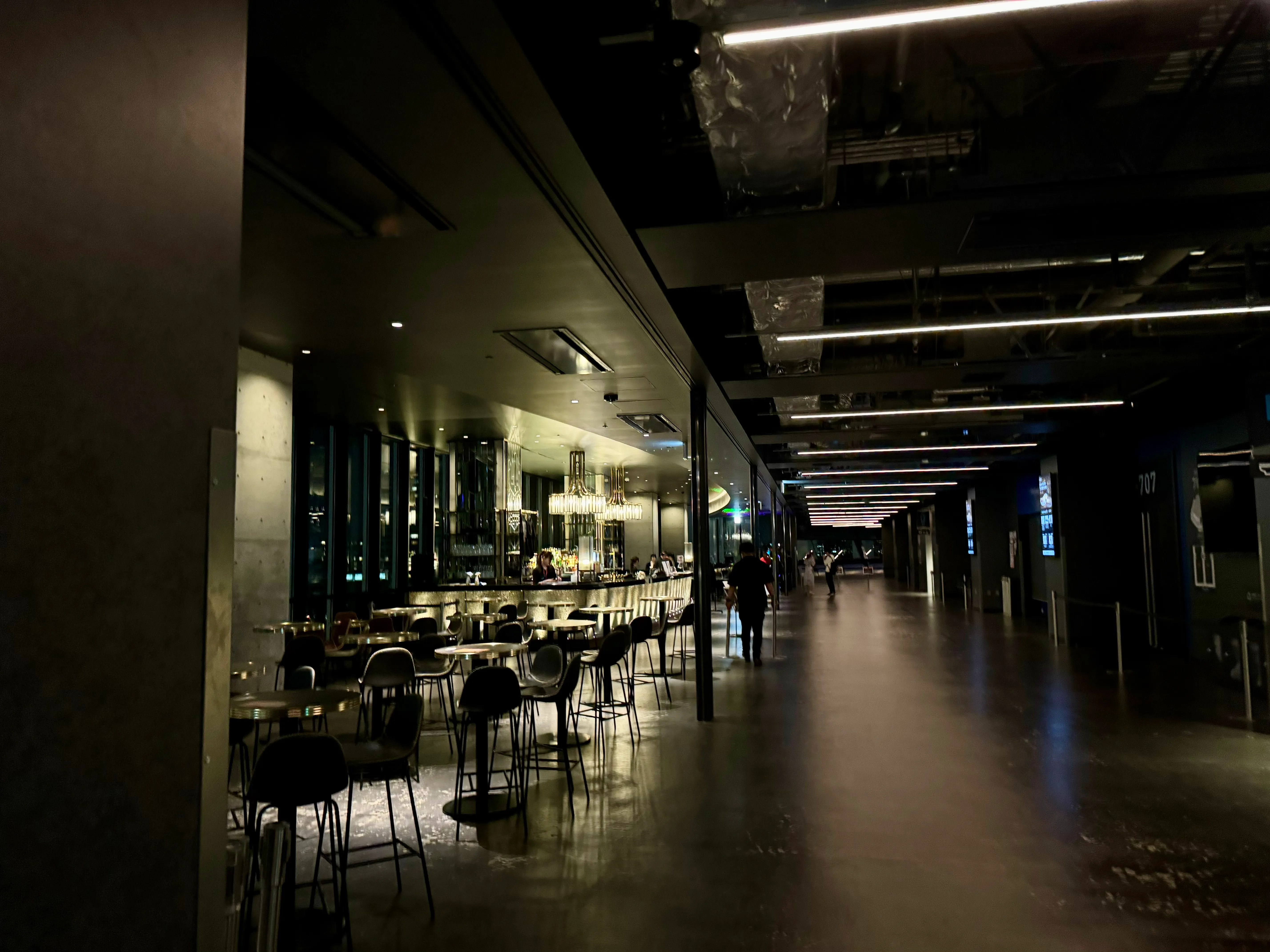
Official Social Media: https://x.com/ArenaBar7 ↗
Arena Bar 7 is a unique facility of K-Arena. On the 7th floor of the venue, there is a bar operating. It’s usually open on Fridays, Saturdays and Sundays but for most accurate information you should check the official Twitter account, which regularly posts the schedule for the live.
While the ability to buy drinks at a venue isn’t unique in itself, the Arena Bar has two unique propositions
- Friday night DJ events - Come the evening before to a DJ/Bar experience that ends by 10PM. Leaving you time to get some rest before the main event on Saturday.
- Post-event hangout space right at the venue
For more details I will be writing a more complete article at some point that covers the full experience and offerings of the Arena Bar itself, once thats done there will be a link here, so check for updates.
Having a bonus activity or afterparty spot where fans will gather is a big draw for K-Arena, and if you like packing your trip with action it can be a great place to visit.
Entry is permitted even if you don’t hold a live ticket on concert days, follow instructions at the venue on how to queue for its dedicated elevator. If you are not at Level 7 for the event, you may be forced to leave and re-enter through this method as well.
VIP Lounge#
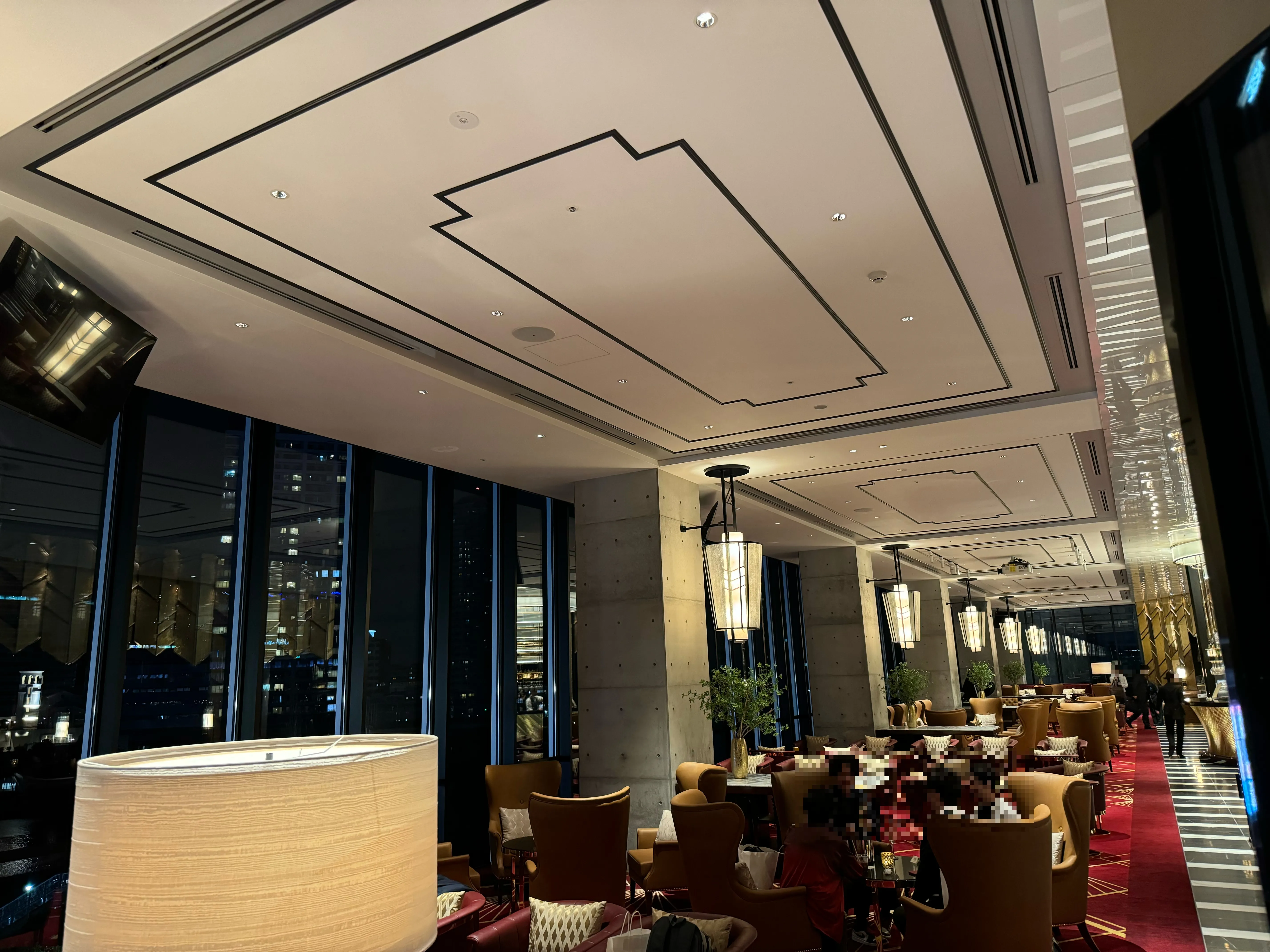
K-Arena also features a very unique VIP experience that it barely talks about. On level 6 of this venue lies an extremely fancy high end lounge designed for the ultra wealthy and elite. The menu spreads from 600 JPY soft drinks all the way to 1.2 million JPY red wine which can make bottles of Dom or Kreug look “affordable”.
What’s also unusual is that sometimes organizers will allow average people to ticket for this premium experience at eyewatering prices, which makes this relevant to general attendees.
This lounge features its own toilets and is probably the only toilet in the whole venue that has all heated taps, mouthwash, toothpicks, cotton buds and a cast iron paper towel holder.
The lounge connects to a set of private rooms that are glass boxes with blinds. The middle room “V” is especially fancy, with double the capacity and much more elaborate finishing. These glass boxes have a door that will bring you to the VIP seating area.
Similar to the Arena Bar, you are able to utilize the lounge area after the live for about 1.5 hours extra (exact times depend on organizer) which makes it a nice place to hang around. However, you are usually not allowed to return to the private rooms.
I will write a more complete VIP lounge review in a separate article, which will be linked to once it’s ready. But if any of this sounds appealing to you, this is legitimately one of the more unique experiences that K-Arena offers.
Exiting & Crowd Control#
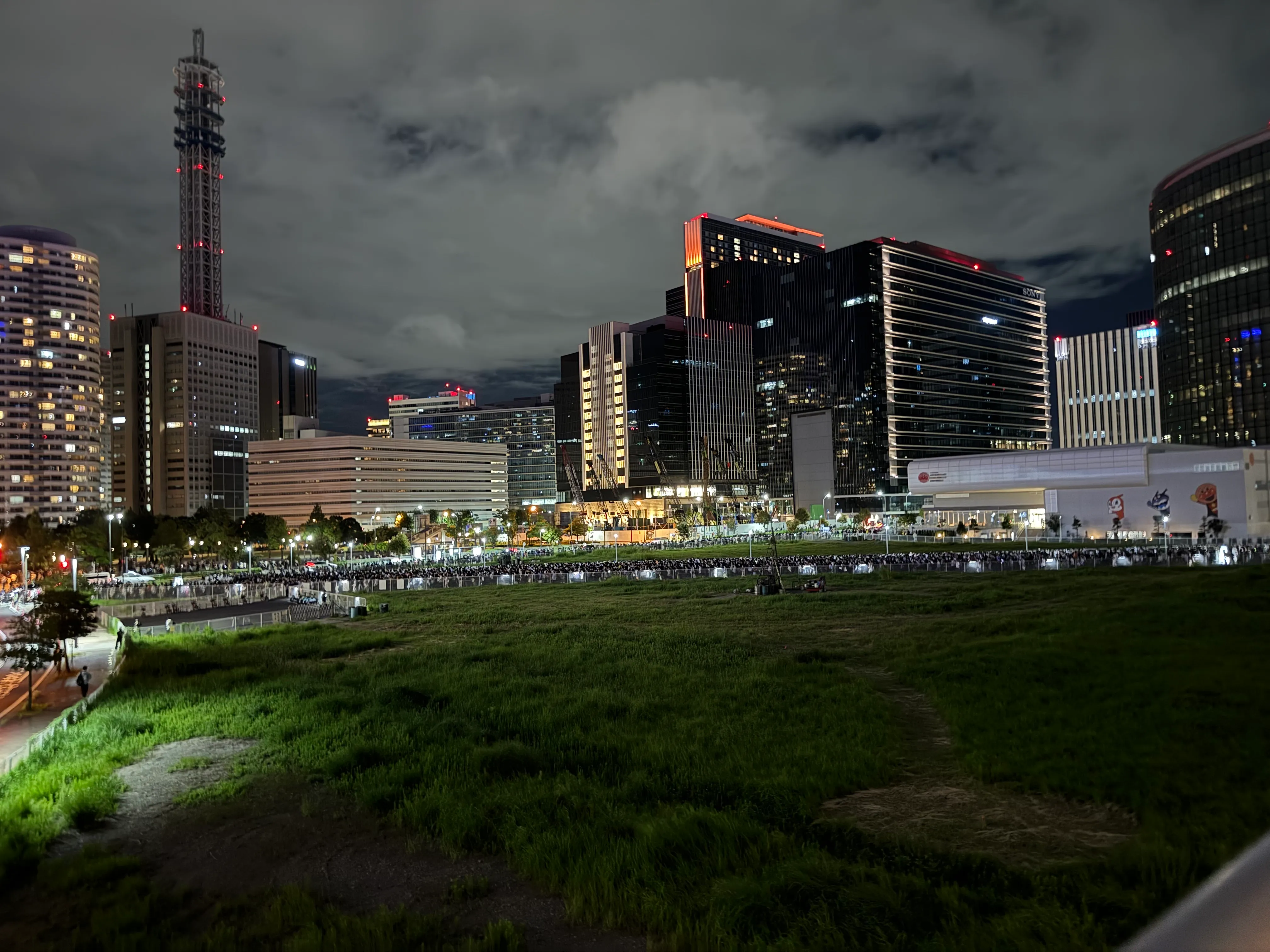 Welcome to the real K-Arena Experience
Unfortunately, leaving the event remains one of the weak points of K arena. During exit control, there is usually only two routes from the Music Terrace that are permitted. One route goes past the entrance to BAYDECK Grill & Bar towards the Anpanman museum, the other route takes the new walkway across the train tracks. This second exit is crucial because if you were going to Yokohama, this grants you access to the pathway that goes towards the Hanamirai Walk bridge near Nissan HQ if permitted. This sidesteps having to deal with the crossing across Shin-Takashima, which is the second major choke point.
I have provided an illustrated diagram that shows you the general options. Major choke points circled in black.
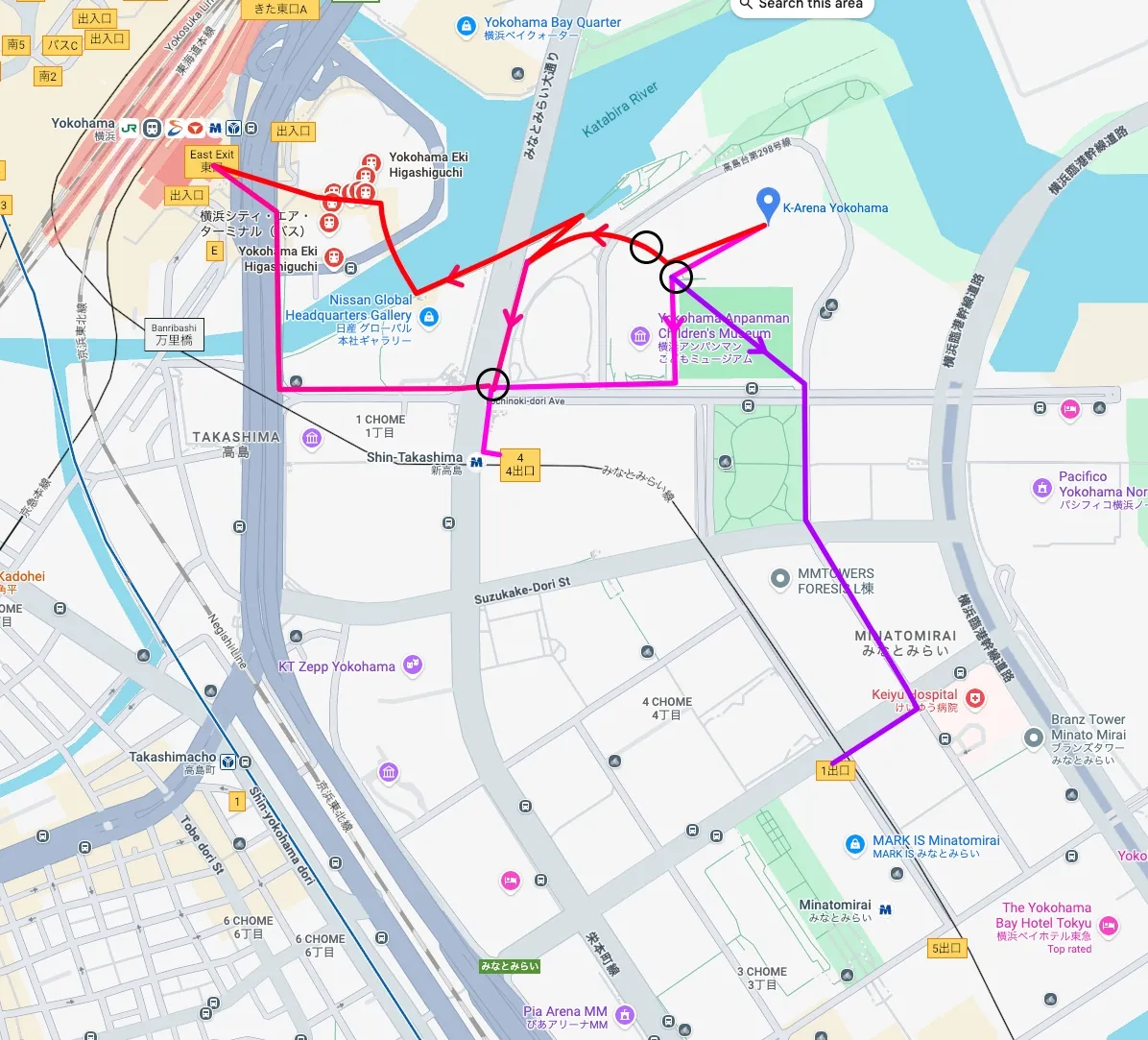 Crowd control exit routes for K-Arena Yokohama to the 3 nearest stations
The Minatomirai route dodges the need to take the Shin-Takashima crossing, which will cut out a major choke point. Recommended for people who are connecting via the Minatomirai line and prefer to avoid the chaos of Shin-Takashima during the exit rush.
If you are on a tight connection after the event, leave on the last song or right as the final song ends. The small timing advantage would allow you to sidestep the crowd and make it through the chokepoints significantly faster before the rest of the venue gets there.
Where to eat after the Show#
Now after the live this gets a bit trickier. Options remain the same as before, but two constraints are added:
- What is the last order time of the chosen place?
- What is the last train connection time you (and your friends) need to make in order to return to lodging?
The former is a universal constraint and the latter can be a big factor if you or the people you’re hosting don’t stay in Yokohama. This is because connecting northwards to various destinations may require leaving by 11pm. Be aware that some places close as early as 9PM and 10:30PM is the median last order time around this area.
In practice I’ve found that getting to Yokohama takes about 20-30 minutes, but the difference between early and late leavers can vary an additional 30 minutes due to crowd control. If you are reserving a restaurant, consider adding 1 hour additional buffer, especially if everyone has to be present before you can be seated.
Side notes: Arena Bar 7 is valid if you only need light food but don’t consider it a full meal replacement. I have also seen several instances in 2025 where all 120+ seats at Baydeck Grill & Bar was fully booked out by fans organizing a massive afterparty, so don’t assume that its an option if you don’t have a reservation.
Where to Stay#
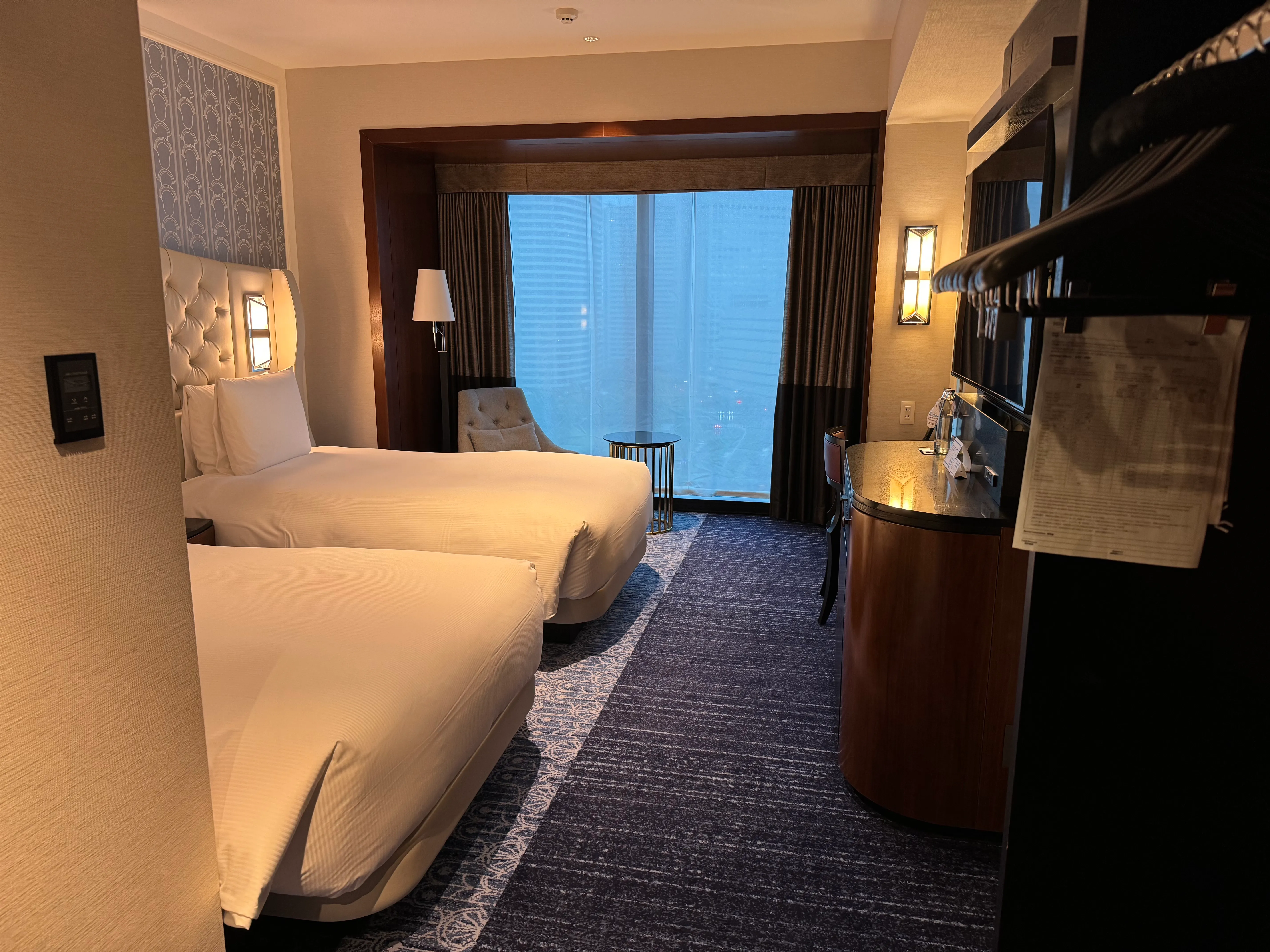 Hilton Yokohama, the closest hotel to the venue.
I cannot provide information on all possible hotels and all valid lodging areas, but I can provide general suggestions on what I feel are some good choices. Do note that all the options near the venue are highly susceptible to price spikes during concert weekends and is also a touristy area in general, so I recommend securing a room as soon as possible at any hotel you’re ok with. A cheaper hotel at a slightly less optimal location can be a better choice than picking a popular spot and paying surge pricing!
In my opinion there are 3 particularly advantageous places to stay
- Hilton Yokohama
- Southern area of Yokohama Bay (Minatomirai Line)
- Yokohama Station area
Hilton Yokohama
Will write a separate hotel review in the future as I think it deserves a more nuanced discussion, but for now here are the key reasons
- Literally right next to the venue, unbeatable convenience
- Lets you have a private bathroom, shower and storage area on live day
- Much larger rooms and more well finished compared to 3 star hotels around the area
Key Downsides
- The price. If you can’t split a room among 2-3 people you are paying nearly 3x what a normal room around Yokohama Bay costs.
- No great breakfast options around the area without a long walk, making forking up for hotel breakfast additional cost
- No great dinner options even if returning to the hotel after the live is dead easy. Room service or hotel restaurant is pricy.
Southern Area of Yokohama Bay
Advantages
- Easier to get to after the live ends as most of the crowd is rushing northwards towards Yokohama Station and Tokyo
- Much more affordable than Hilton, especially if you stay around the Bashamichi area where 3* hotels are more plentiful
- Still close to the venue
Disadvantages
- Requires a train connection to get to Yokohama station if your plans involve anything other than just attending the event.
Yokohama Station area
Advantages
- Near a good major station with a lot of connections
- Better for trips where you may need to do something other than just attend an event at K-Arena
- Food options are a lot better than any of the other choices
Disadvantages
- Has probably the worst price spikes in the area
- You are competing with people attending events at Yokohama Arena for space
- Still going “with” the crowd rather than “against” it when leaving the venue
Conclusion#
My personal opinion of K-Arena Yokohama is that it’s a generally pleasant and “safe” venue where the downsides are known quantities that you can plan around.
- Venue capacity is large for an arena, so I’m less worried about tickets being unobtainable
- Seat quality is good, views are generally unobstructed
- Venue acoustics are a non issue
- Toilets are plentiful
- F&B choices around the venue for post event meals is sufficient
- Major downsides like the venue exit and crowd control experience can be mitigated if you’re prepared
Plenty of venues lack some of these upsides while still sharing the same exit headaches (or worse). With a bit of planning, K-Arena is an easy venue to have a good night at.
Just don’t confuse Yokohama Station with Shin-Yokohama Station if you’re aiming for the Shinkansen, those are very different places.
If this guide was useful, the newsletter is worth a look. It covers updates and revisions to guides like this one whenever venues change or a new visit warrants it, so the information you’re relying on stays current. Occasionally it features other pieces that don’t fit the guide format but are worth your time if you’re navigating live events in Japan.
Subscribe Here